Tea, trust, and hacking – how Birmingham is getting Smarter

(The Custard Factory in Birmingham, at the heart of the city’s creative media sector)

As I described in my last article on this blog, the second meeting of Birmingham’s Smart City Commission last week addressed the question: “what will make Birmingham a Smart City, not just a place where a few “smart things” happen?

A large part of our discussion was concerned with the way a city-level Smart initiative can engage in and enable the communities and individuals who are already creating innovations in the city.

Nick Booth of Podnosh told the Commission about his work running social media surgeries in Birmingham. Nick helps these conversations to take place across the city’s communities; their purpose is to share an understanding of the power that social media can offer to communities to share resources more effectively and create social value. Nick and the volunteers he works with were recently honoured by the UK Prime Minister, David Cameron, with a “Big Society Award” in recognition of their work.

Social media is not the answer to all the challenges of Smarter Cities; but it still has tremendous unrealised potential to contribute to them. I’ve written many times on this blog about the fundamental changes that internet and social media technologies have caused in industries such as publishing, music and video over the last decade; but there are still many communities who are not yet making full use of them.

The physicist and biologist Geoffrey West’s work has shown that the nature of human social behaviour creates a feedback loop that will lead to ongoing growth in the size and density of city populations; and this in turn will create ongoing increases in the consumption of resources. As I remarked recently, there’s a growing consensus that we cannot continue to consume resources at the rate that this growth suggests. The solution, according to Professor West, is to create changes in the way that social and urban systems work. He is not prescriptive about what those changes should be; but in my view we have already seen enough examples of the use of social media to create sustainable systems to suggest that it could be at least part of the solution. Examples include Carbon Voyage‘s system for sharing taxis;  the business-to-consumer and business-to-business markets in sustainable food production operated by Big Barn and Sustaination; and the Freecycle recycling network.

(Photo of a Social Media Surgery held in Birmingham by Nick Booth. The surgeries have now spread across the UK and to five other countries).

The social media surgeries that Nick runs in Birmingham are helping communities to create similar innovations for themselves. What makes them work is the personal philosophy that’s applied by those who engage in them: a willingness to “turn up and have something to offer” in an informal conversation.

In answer to the question “what could make Birmingham a Smart City?”, Nick went so far as to reply “having more conversations over cups of tea”.

Nick’s comment reminded me of one of the quotations from Hagakure: The Book of the Samurai that appears in Jim Jarmusch’s film “Ghost Dog“:

Among the maxims on Lord Naoshige’s wall there was this one: Matters of great concern should be treated lightly. Master Ittei wrote: Matters of small concern should be treated seriously.

The point is that behaving “lightly” and taking the trouble to go to meet people in the environments where they are comfortable are profoundly important components of the approach that makes social media surgeries work. They create trust, and invite contribution and co-creation. And they encourage those who receive help at one surgery in turn to offer help at another.

Several of us came together in Birmingham last weekend for another conversation to create value in the city: the “Smart Hack” organised by Gavin Broughton at Birmingham Science Park Aston – an example of the increasingly common “hackathons” in which developers contribute their time and expertise to create new “apps” for the cities where they live. I was really pleased that IBM helped to fund the facilities and catering for the event.

(As a brief aside: the word “hacking” can mean many things; but when it is used by computer programmers in this context, it means using technology in a clever and innovative way to solve a problem. It is a very positive activity. Some programmers would even describe the astonishing technology innovations that made it possible to land on the moon in 1969 as “hacks”, and would consider doing so to be a demonstration of their deep respect and admiration for the scientists and engineers involved).

Following a series of introductory provocations about Open Data and Smarter Cities technologies, about thirty of us discussed the challenges and opportunities facing Birmingham that such approaches could apply to. Within a short time, an idea had been proposed which seemed viable – could an “app” be created to connect charities that distribute food to catering services who might have leftover food to spare?
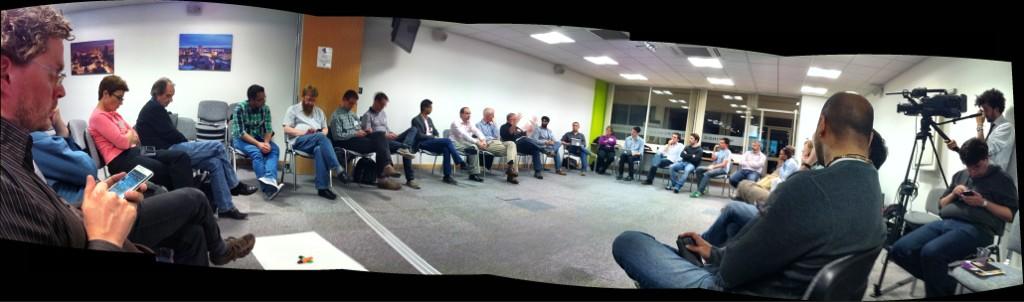
(The discussion group at #SmartHack in Birmingham photographed by Sebastian Lenton)

The importance of addressing wastage and efficiency in urban food systems is something that I’ve written about before on this blog. The idea the Smart Hack team created was carefully formulated as a way to reduce food wastage that would be compliant with food safety and hygiene legislation. A smaller team of 10 or so coders subsequently spent Saturday and Sunday building an app based on the idea, fuelled by beer and pizza – and by their own willingness to contribute to their city.

In Birmingham’s Smart City Commission we discussed how conversations such as social media surgeries and the “Smart Hack” lead to innovation; and asked whether they represent a “soft infrastructure” for Smarter Cities in which it is just as worthwhile to invest as the “hard infrastructure” with which we are perhaps more familiar – open data portals, network infrastructure and so on. I certainly think they do. I’ve spent today at the “Smart Infrastructure” summit organised by IBM and the Start Initiative having a similar discussion focussed on challenges, opportunities and communities in Glasgow, and the same thinking seemed to apply there.

(Coders at work at the Birmingham “Smart Hack”, photographed by Sebastian Lenton)

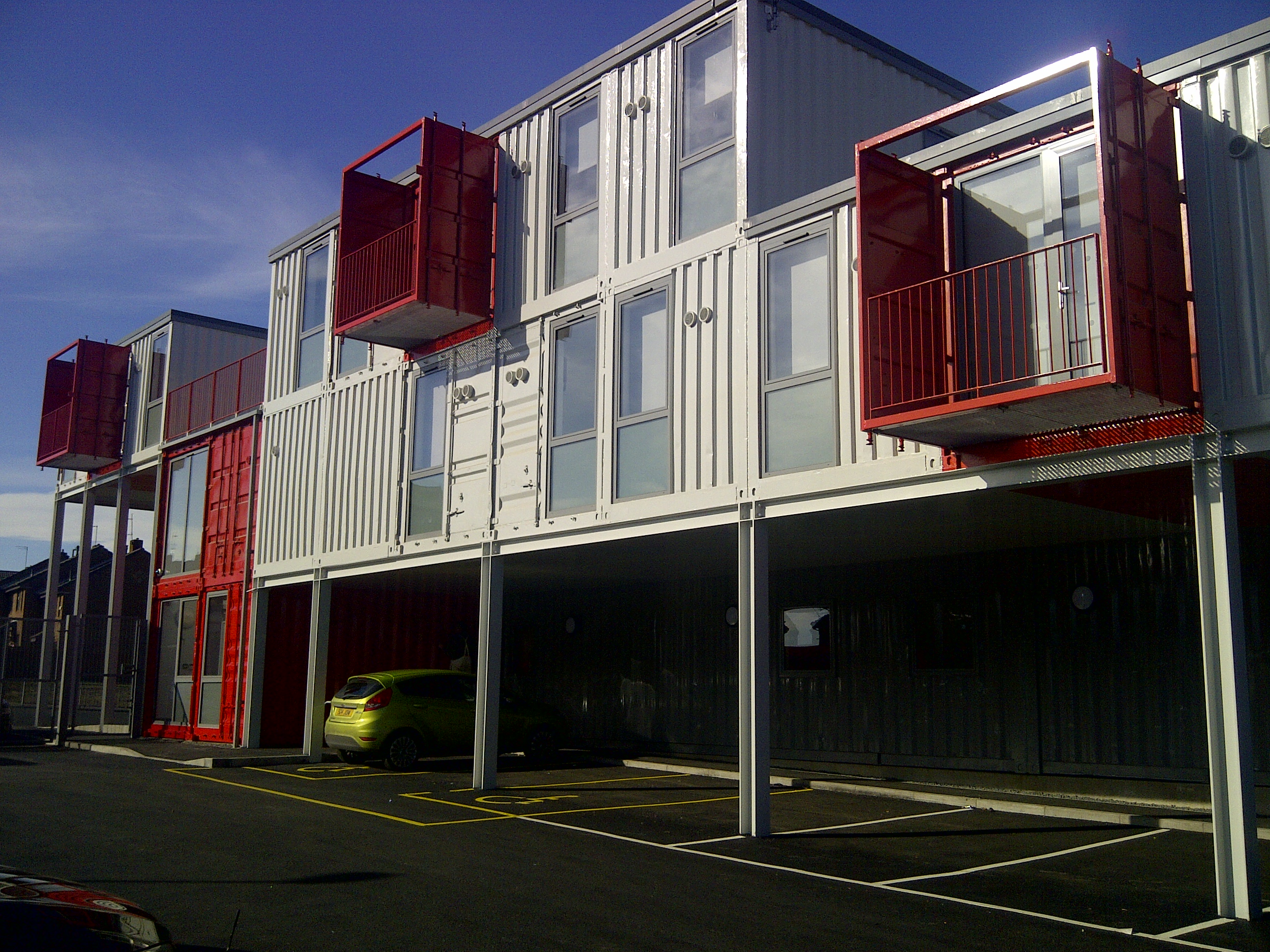
This approach of engagement through conversation also offers cities a chance to deliver new “hard” infrastructures for Smarter Cities that are better suited to the needs of communities, innovators, citizens and businesses: by becoming a “listening” city, and by understanding and then removing some of the barriers that make it hard for small organisations to create successful innovations. That might mean investing in broadband or wireless internet coverage in areas that don’t have it; making public sector procurement processes more open to small businesses; or simply helping communities to win funding to build better places in which to come together to communicate and create ideas, such as the new “Container City” incubation facility for social enterprises in Sunderland.

The European Union recognised the importance of supporting social innovation this way in a recent report, “Empowering people, driving change – social innovation in the European Union“, and the European Commission’s president José Manuel Barroso will launch a social innovation competition on 1 October, the “Europe Social Innovation Prize“. The Guardian newspaper in the UK wrote an interesting article about these annoucements, and offering several other examples of the power of community-based social innovation.

If we are really going to make our cities “Smarter” and more successful, then we must allow all of the individuals and communities in cities to participate in that process. The way to start doing that is through conversations that build trust and create the environment for inclusive innovation. Tea, trust and hacking. It’s what will make Birmingham – and every other city – Smarter.

(This article and the events it describes are the result of the activities of many people, several of whom appear in the photographs I’ve used by Sebastian LentonNick Booth of Podnosh; Gavin Broughton; David Roberts of DropletPay; James Cattell who following his great work on Open Data for Digital Birmingham has recently joined the Government Digital Service; Andy Mabbett; Oojal Jhutti of iWazat – who first suggested the idea for the food “app” at the “Smart Hack” event; and Andy Cowin of Sanfire who has forgotten more about creating innovation through conversations than I’ll ever know. I also owe a deep debt of thanks to Tom Baker and his colleagues at Sunderland City Council for introducing me to some of the amazing social innovators in Sunderland at the start of our work on Sunderland’s “City Cloud” – they have been an inspiration to me ever since).

Ten ways to pay for a Smarter City (part two)

(Photo of the Brixton Pound by Charlie Waterhouse)

As I wrote recently, cities across the world are pursuing Smarter City strategies for common reasons including demographics, economics and the environment; but they start in very different social, financial and organisational positions. So there is a need to consider a variety of mechanisms when looking for the financial means to support those strategies.

Last week I discussed five ways in which cities can finance Smarter initiatives; they included tried-and-tested sources such as research grants, and more exploratory ideas such as sponsorship. In this post I’ll consider five more.

6. Approach ethical investment funds, values-led banks and national lotteries

Whilst the current state of the global economy has focused attention on the monetary aspects of our financial systems, in the context of Smarter Cities it is important to note that amongst the great variety of investment instruments are some which have social and environmental objectives.

I was honoured last week to attend the official opening of Sunderland’s new business support facility for social enterprises, Container City, operated by Sustainable Enterprise Strategies (SES). The centre, fabricated from 37 re-conditioned and adapted shipping containers, provides a new basis from which SES can support the hundreds of social enterprises and traditional businesses that they help to start and operate each year; and who provide services and employment in some of the city’s most disadvantaged areas.

Several of these organisations use emerging technologies in innovative ways to promote social outcomes in the city – such as Play Fitness whose “Race Fitness” product uses gamification to encourage children from deprived communities to engage in fitness and wellbeing; or See Detail who provide employment opportunities in software testing for people on the Autistic spectrum. I’ve argued before that this sort of innovation in communities can be a powerful force for making cities Smarter.

SES are supported by a variety of means, including financial institutions with mutual status, and funding programmes aimed specifically at encouraging social enterprise. The UK’s National Lottery provides one such programme, the “Big Lottery Fund“, which aims to support community groups and projects that improve health, education and the environment.

These sort of schemes operate in many countries, in addition to the ethical investment funds available in international markets. Community Interest Companies are another example of the new forms of organisation that are emerging to take advantage of them. Credit Unions and other forms of mutually owned or locally focussed financial institutions exist across the world; and the Global Alliance for Banking on Values recently issued a report stating that what it calls “sustainable banks” are outperforming their mainstream counterparts.

Such organisations will often demand a financial return in addition to social and environmental outcomes; but well-formed investment proposals for Smarter initiatives should be capable of meeting those objectives.

7. Make procurement Smarter

(Photo of a smart parking meter in San Francisco by Jun Seita)

Cities already spend hundreds of millions to billions of Pounds, Euros and Dollars each year operating city systems; and buying products, materials and services to support them. The scoring criteria in those procurements can be a powerful tool to create smarter cities.

Systems such as utilities, transport and maintenance of the environment are often contracted out to the private sector. If procurement criteria for those contracts are specified using traditional measures for the provision and cost of capability, then suppliers will likely offer traditional solutions and services. However, if procurements specify requirements for outcomes and innovation in line with a Smarter City strategy, then suppliers may offer more creative approaches.

Cities could specifically procure Smarter systems such as smart meters for water and power; or they could specify outcome-based procurement criteria such as lowering congestion or carbon impact in traffic systems; or they could formulate more open criteria to incent innovation and creativity. Jackie Homan of Birmingham Science City recently wrote a great article describing how some of those ideas are being explored in Birmingham and Europe.

8. Use legitimate state aid

A significant component of many Smarter City strategies is to stimulate economic and social growth in the less economically active areas of cities. Such initiatives often run into a “chicken-and-egg” or “bootstrapping” problem: new businesses need infrastructures such as broadband connectivity to start and succeed; but until an area has significant business demand, network providers won’t invest in deploying them.

Birmingham and Sunderland have both addressed this problem recently, winning exemptions from or avoiding conflict with European Union “State Aid” legislation to secure city-wide broadband deployments.

It’s important to make sure that such infrastructures are accessible. In the same way that a new city highway can divide the communities it passes through rather than linking them, it is important that new technology infrastructures are designed in consultation with local businesses and communities in order to provide capabilities they really need, through commercial models that they can afford to use.

Tax increment financing, which allows government bodies to use projected future increases in tax and business rates returns to justify investment in redevelopment, infrastructure, and other community-improvement projects, is another mechanism that can be used in this way. In the UK, the national government is undertaking an important extension of this thinking by agreeing a set of individual “City Deals” with cities such as Leeds and Birmingham, giving them new autonomous powers over local taxation and investment.

(Developers at City Camp Brighton explore ways in which collaboration and web technologies can contribute to the city’s future. Photo by Richard Stubbs)

9. Encourage Open Data and Hacktivism

Communities can bring great passion and resources to bear in finding new ways for their cities to work. In the domain of technology, this is exemplified in the phenomenon of “Hacktivism” in which volunteers lend their time and expertise to create new urban applications.

As I’ve discussed before, when this willingness to contribute is combined with the movement to Open Data and the transformation underway to regional shared services in public sector, powerful forces can be unleashed.

Code for America have championed this agenda in the United States, and this year Code4Europe was launched to promote a similar level of engagement in Europe.

There are limits to what can be achieved for free. But in my view great potential exists, particularly if City authorities can work in partnership with these movements to provide secure, scalable, open technology infrastructures that they can exploit.

However unfamiliar the produce, markets still need physical, infromation and governance infrastructure

10. Create new markets

For a long time I’ve considered that we should conceive of the platforms that support Smarter Cities not just as technology infrastructures, but as marketplaces – i.e. systems of transactions that take place on those new infrastructures. Marketplaces create money-flows; and marketplace operators can extract revenues from those flows which in return create the case for investing in the marketplace infrastructure in the first place. Further; by opening up the marketplace infrastructure to innovative local service providers, unforeseen new Smarter systems can be created.

There are many examples of new markets that use technologies such as social media and analytics to identify parties between which new transactions can be performed; and that then provide the infrastructure and governance to carry out those transactions. Craig’s List and E-Bay are well-known general marketplaces; whilst Freecycle specialises in the free distribution of unwanted items for re-use in communities. Zopa and Prosper apply these ideas to peer-to-peer lending and investment.

Similar markets with specific relevance to city systems are emerging. Streetline offer a Smarter Parking solution which could be viewed as a marketplace in parking spaces; and Carbon Voyage‘s system for sharing taxis can be seen as a marketplace for journeys. I’ve explored other examples of local, marketplace-based business models in food and energy in previous articles on this blog; and discussed some of the local currency and trading systems emerging to support them.

What these examples have in common is that they are independent businesses or social enterprises who are winning backing from investors because they have the potential to generate revenue. As I argued in the case of Open Data and Hacktivism above, if cities can find ways to support such innovative businesses, they’ll find another community that is able to help them achieve a Smarter City transformation.

The buck doesn’t stop here

The ideas for funding Smarter Cities that I’ve discussed over the last two weeks are certainly not exhaustive; and as a technologist rather than an economist or financier I certainly don’t consider them definitive.

But hopefully I’ve provided enough examples in support of them to demonstrate that they are realistic approaches with the potential to be re-used. I certainly expect to see them all play a role in financing the transition to the cities of the future.

Ten ways to pay for a Smarter City (part one)

Birmingham’s striking new Library, which will open in 2013, is one example of the regeneration projects currently underway in cities despite the challenging economic climate.

I’ve been meeting frequently of late with academic, public sector and private sector partners in city systems to explore the ways in which Smarter City initiatives are funded. Whilst many such programmes are underway, it is still the case that individual cities starting on this path find that it can take considerable time to identify and secure funds.

The ultimate stakeholder in Smarter City initiatives is often a local authority – they alone have the responsibility to ensure the functioning and success of a city as a whole. But whilst some reports show that private sector sentiment is finally improving following the 2008 crash, public sector – and in particular, local government – is still in the grasp of an unprecedented squeeze in funding. So where can city authorities look for the – sometimes substantial – funds needed to support Smarter City initiatives?

Up to now, a great many Smarter City initiatives have been funded at least in part by research grants. By their nature, these will only fund the first projects to explore Smarter City concepts – they will not scale to support the mass adoption of proven ideas. So we need to consider how they are used alongside other sources of funding.

In this post I’ll describe the first five of ten ways that Smarter City initiatives can be funded, including but not limited to research grants. None of them are silver bullets; but they all represent realistic ways to start paying for cities to become Smarter. I’ll describe another five in a follow-up post next week.

The UK Technology Strategy Board’s “Creative Industries Knowledge Transfer Network” (who took this photo) brings innovators in cities together to create new ideas.

1. Apply for research grants to support new Smarter City ideas

Whilst research funding will not pay for widespread adoption of proven Smarter City ideas, it will still support the search for new ideas. And we have certainly not exhausted the supply of ideas – far from it. In the UK, the Technology Strategy Board’s award of thirty £50,000 grants to perform “Future City” feasibility studies has kick-started a frenzy of activity. Just one of the thirty cities awarded these grants will be chosen to receive £24 million to support a demonstrator project; but many of the others will use the results of their feasibility studies to seek independent funds to move ahead.

The European Union recently launched an Innovation Partnership for Smart Cities and Communities that is expected to provide €365 million to support projects demonstrating innovative urban technology systems; and many funding programmes that are not labelled “Smart” or “City” are nevertheless relevant to Smarter Cities – such as the Technology Strategy Board’s “Innovating in the Cloud” funding competition or the UK Engineering and Physical Sciences Research Council’s “Research in the Wild” programme.

From social science to sustainability to healthcare to transport and buildings, many research agendas are relevant to creating the cities of the future; and new, well-formed ideas can always seek support from the relevant funding organisations. In this context, it’s not surprising that we’re seeing ever-closer links being forged between cities and the Universities that are located in them.

2. Exploit the information-sharing potential of shared service platforms

City and regional authority finances are under unprecedented pressure from the acute financial situation and expected demographic changes. In the developed world, we are getting older, and more people who have retired from work need the support of less people who are still working and paying taxes; and in emerging economies, urban populations are growing at a staggering rate.

In order to save money whilst maintaining vital services, local governments are increasingly sharing the delivery of support services such as finance, HR and IT; saving money – and reducing staff – in those functions in order to preserve the delivery of frontline services such as education and social care. It is difficult to overstate the significance of these changes; in the UK, for example, it is expected that nearly 900,000 public sector workers – 3% of the entire national workforce – will lose their jobs over the next five years as a result. Whilst specific characteristics vary from place to place, similar trends are visible across the world.

One outcome of these changes is that shared IT platforms are increasingly in place in cities and regions to support shared services. Those platforms now host co-located, multi-agency data. Cities such as Plymouth, Dublin and Sunderland are starting to explore the benefits that might be realised from that data. In Sunderland, the CEO and CIO have both spoken extensively about the opportunities they see to transform the city and services within it using their City Cloud platform. The East Riding of Yorkshire has been sharing services between agencies for some time, and has reported their achievements in addressing Child Poverty through improving cross-agency information sharing as a result.

These examples all show that whilst the current acceleration of shared services in cities and regions has its origins in adversity, it nevertheless offers the potential to support some positive outcomes too.

3. Find and support hidden local innovations

(Photograph by Meshed Media of Birmingham’s Social Media Cafe, where individuals from every part of the city who have connected online meet face-to-face to discuss their shared interest in social media.)

City populations are not passive observers to the Smarter City phenomenon. They may be crowd-sourcing mapping information for OpenStreetMap; running or participating in hacking events such as the forthcoming Government Open Hackday in Birmingham; or they may be creating new social enterprises or regional technology startups, such as the many city currencies and trading schemes that are appearing. Simply running social media surgeries as Podnosh do in Birmingham, can have a powerful effect on local communities by helping them exploit social technology to uncover hidden synergies and connections.

Individual officers in many councils work very positively with these community innovators. But substantial formal relationships can be impeded by the complexity of public sector procurement regimes which are simply too expensive and time-consuming for very small organizations to engage with. By simplifying procurement practices – or even by being transparent about the level of purchase below which competitive procurement does not apply – the level of engagement between city authorities and these communities could be increased. Bridging organisations can also play a positive role here, such as Sustainable Enterprise Strategies (SES) in Sunderland. SES provide support to the local social enterprise community and act as a link between that community and the City Council.

Local entrepreneurs and innovators often have limited resources. On their own, they are unlikely to implement such Smarter City infrastructures as energy grids or real-time transport information systems, for example. But collectively, their ideas could contribute significantly to the business case for a local authority to invest in such infrastructures. By engaging with this community extensively, a portfolio of potential innovations and outcomes can be created to demonstrate the value of such investments. By drawing on the collective creative energies of the city in this way, that portfolio is likely to contain many more ideas than could be obtained from central agencies alone.

4. Explore the cost-saving potential of Smarter technologies

At the heart of Smarter Cities is the idea that information integration and analytic technologies allow better, more forward looking decisions to be taken within cities; with the potential both to improve outcomes and to reduce costs. Whereas the desired outcomes may be citywide and social or environmental in nature rather than directly financial, many case studies show that short-term cost reductions can also be achieved within a single investing organisation. These cost reductions, of course, can then be the basis of an investment case – as they were for Sunderland’s City Cloud.

The London Borough of Brent in the UK, for example, realised significant cost savings by reducing error and fraud using such technologies, as did Alameda County in the US, who also identified new revenue opportunities (see this case study and this video).

As I dicussed in an earlier blog post exploring this topic, if these technologies are deployed on the shared IT platforms described above, then once in place they can be re-used for other purposes. This might lower the cost of deploying subsequent solutions elsewhere in city systems, such as traffic prediction for commuters in order to reduce the congestion that lowers economic productivity and job creation in cities; or predictive analytics to enable preventative approaches to social care, as demonstrated by Medway Youth Trust.

5. Could Smarter Cities be sponsored?

The Miami Dolphin’s Sun Life Stadium photographed by Bob Brown

In recent times we have become used to the idea that sports stadiums take their names from sponsors who fund the teams that own them, such as Arsenal Football Club’s Emirates Stadium. Such facilities are cities in microcosm in many respects, operating their own power, transport, safety and other systems analogous to those found in cities. Some, such as the Miami Dolphin’s Sun Life Stadium are already transforming those systems to become Smarter Stadiums.

Other facilities such as ports, airports, industrial plants, shopping malls and University campuses can be considered “micro-cities” in a similar way; and as I have commented before some of these are large enough that transforming their systems can make a significant contribution to transforming the cities in which they are based.

Could the concept of sponsorship be extended beyond sports stadiums? It has certainly been applied to entertainment facilities such as the O² Arena; and many airports have changed their names for marketing and branding purposes. 

I don’t expect we’ll see a city renamed by a corporate sponsor anytime soon, and novels such as Max Barry’s “Jennifer Government” and Rupert Thomson’s “Soft” have cautioned against such ideas. As past controversies around privatisation and commercialisation in areas of education and the justice system suggest, there are certainly city systems for which this idea could be challenging or simply inappropriate. But with cities increasingly conscious of the value of their brands in attracting investment and business, and with local employers conscious of the need for cities to seem attractive to the skilled people they need to employ, the possibilities for sponsorship to support some form of investment in appropriate Smarter City systems or facilities – especially those that are already private sector components of the city ecosystem – could be worth considering.

Funding the Smarter City roadmap

It’s very unlikely that any of the ideas I’ve discussed here will fund an entire Smarter City transformation, of course. But they are all realistic possibilities to fund elements of such a transformation. The challenge for cities is for their stakeholders to come together and agree how they will collectively exploit all of these ideas – and more – in funding the elements of a programme that they agree to undertake together.

Next week I’ll continue this discussion by exploring five more ways for cities to fund and support Smarter initiatives.

The amazing heart of a Smarter City: the innovation boundary

(Photo of a mouse by pure9)

Innovation has always been exciting, interesting and valuable; but recently it’s become essential.

The “mouse” that defined computer usage from the 1980s through to the 2000s was an amazing invention in its time. It was the first widely successful innovation in human/computer interaction since the typewriter keyboard and video display which came decades before it; and it made computers accessible to new communities of people for the first time.

But whilst the mouse, like the touchscreen more recently popularised by the iPhone and iPad, was a great innovation that increased the usability and productivity of personal computers, it wasn’t really necessary for a greater and pressing purpose. Its benefits came later as we explored its capabilities.

We now have a greater purpose that demands innovation: the need to make our cities and communities more sustainable, vibrant and equal in the face of the severe economic, environmental and demographic pressures that we face; and that are well described in the Royal Society’s “People and the Planet” report.

We have already seen those pressures create threats to food and energy security; and in recent months I’ve spoken to city leaders who are increasingly concerned with the difference in life expectancy between the most affluent and most deprived areas of their cities – it can be 10 years or more. There are much worse inequalities on a global scale, of course. But this is a striking local difference in the basic opportunity of people to live.

Barnett Council in North London famously predicted recently that within 20 years, unless significant changes in public services are made, they will be unable to afford to provide any services except social care. There will be no money left to collect waste, run parks and leisure facilities, clean streets or operate any of the other services that support and maintain cities and communities. I have spoken informally to other Councils who have come to similar conclusions.

All the evidence, including the scientific analysis of the behaviour and sustainability of city systems by the Physicist Geoffrey West, points to the need to create innovations that change the way that cities work.

But where will this innovation come from?

I think innovation of this sort takes place at an “innovation boundary”: the boundary between capability and need.

When a potentially transformative infrastructure such as a Smarter City technology platform is designed and deployed well, then the services it provides precisely embody that boundary.

This idea is fundamental to the concept of Smarter Cities, where we are concerned with the capability of technology to transform cities. Technology vendors – including, but not limited to, my employer IBM – are sometimes expected to use the Smarter City movement as a channel through which to sell generic technology platforms. As vendors, we do deliver technology platforms for cities, and they are part of the capability required to transform them. But they are not the only part – far from it. And they must not be generic.

(A smartphone alert sent to a commuter in a San Francisco pilot project by IBM Research and Caltrans that provides personalised daily predictions of commuting journey times – and suggestions for alternative routes.)

As I hope regular readers of this blog will know, I often explore the role of people and communities in transforming how cities work. A city is the combined effect of the behaviour of all of the people in it – whether they are buying food in a supermarket, traveling to work, relaxing in a park, planning an urban development or teaching in a school. No infrastructure – whether it is a road, a building, a broadband network or an intelligent energy grid – will have a transformative effect on a city unless it engages with individuals in a way that results in a change of behaviour. Work by my colleagues in IBM on transportation in California (pictured, left) and on water and energy usage in Dubuque, Iowa provide examples of what can be achieved when technology solutions are designed in the context of individual and community behaviour.

The innovations that discover how technology can change behaviour are sometimes very localised. They can be specific to the nature, challenges and opportunities of local communities; and are often therefore created by individuals, entrepreneurs, businesses and social enterprises within them. The “civic hacking” and “open data” movements are great examples of this sort of creativity.

But this is not the only sort of innovation that is required to enable Smarter City transformations. The infrastructures that support cities literally provide life-support to hundreds of thousands or millions of individuals. They must be highly resilient, performant and secure – particularly as they become increasingly optimised to support larger and larger city populations sustainably.

The invention, design, deployment and operation of Smarter City infrastructures require the resources of large organisations such as technology vendors, infrastructure providers, local governments and Universities who are able to make significant investments in them.

The secret to successfully transforming cities lies at the boundary between local innovations and properly engineered platforms. “Smarter City” transformations are effective when new and resilient information infrastructures are designed and deployed to meet the specific needs of city communities. One size does not fit all.

A technology infrastructure is no different in this regard to a physical infrastructure such as a new urban highway. In each case, there are some requirements that are obvious and generic – getting traffic in and out of a city centre more efficiently; or  making superfast broadband connectivity universally accessible. But other crucially important requirements are more complex, subtle and varied. How can a new road be integrated into the existing environment of a city so that local communities benefit from it, and so that it does not divide them? What access points, support and funding assistance are needed so that communities can use superfast broadband networks; and what services and information can be delivered to them using those networks that will make a difference?

If we understand those requirements, we can design infrastructures that properly support the innovation boundary. Doing so demands that we address three challenges:

Firstly, we must identify the specific information and technology services that can be provided to individuals, communities, entrepreneurs, businesses and social enterprises to help them succeed and grow. I’ve referred many times to the Knight Foundation’s excellent work in this area; it has inspired my own work with entrepreneurs and social enterprises in Sunderland and elsewhere.

(Meeting with social entrepreneurs in Sunderland to understand how new technology can help them)

Secondly, we need to understand and then supply the heavily engineered capabilities that are beyond the means of local communities to deliver for themselves; but that which enable them to create innovations with real significance.

At the 3rd EU Summit on Future Internet, Juanjo Hierro, Chief Architect for the FI-WARE “future internet platform” project, addressed this topic and identified the specific challenges that local innovators need help to overcome, and that could by provided by city information infrastructures. His challenges included: real-time access to information from physical city infrastructures; tools for analysing “big data“; and access to technologies to ensure privacy and trust. As we continue to engage with communities of innovators in cities, we will discover other requirements of this sort.

Finally, the boundary needs to be defined by standards. Many cities will deploy many information infrastructures, and many different vendors will be involved in supplying them. In order that successful local innovations can spread and interact with each other, Smarter City infrastructures should support Open Standards and interoperability with Open Source technologies.

It will take work to achieve that, of course. It is very easy to underestimate the complexity of the standards required to achieve interoperability. For example, in order to make it possible to safely change something as simple as a lightbulb, standards for voltage, power, physical dimensions, brightness, socket shape and fastening type, fragility and heat output are required. Some standards for Smarter City infrastructures are already in place – for example, Web services and the Common Alerting Protocol – but many others will need to be invented and encouraged to spread. Fortunately, the process is already underway. As an example, IBM recently donated MQTT, a protocol for connecting information between small devices such as sensors and actuators in Smarter City systems to the Open Source community.

(The first “Local Gov Camp” unconference in 2009, attended by community innovators with an interest in transforming local services, held in Fazeley Studios in Birmingham. Photo by s_p_a_c_e_m_a_n)

In the meantime, the innovation boundary is an amazing place to work. It puts me in contact with the leading edge of technology development – with IBM Research, and with new products such as the Intelligent Operations Centre for Smarter Cities. And it offers me the chance to collaborate with the academic institutions and thought-leaders who are defining the innovation boundary through initiatives such as “disruptive business platforms” (see this work from Imperial college, or these thoughts from my colleague Pete Cripps).

But more importantly, my work puts me in touch with innovators who are creating exciting and inspiring new ways for cities to work; often in the communities that need the most help, such as Margaret Elliott in Sunderland; Mark Heskett-Saddington of Sustainable Enterprise Strategies; and the team at Droplet in Birmingham.

I count myself terrifically honoured and lucky to have the privilege of working with them.

Could the future of money be city currencies?

(Photo of a halfpenny minted by Matthew Boulton in Birmingham; from Smabs Sputzer)

It’s just possible that this week marks a tipping point in the events that have engulfed the UK banking industry since the economic crisis that began in 2008.

Around that time, I questioned whether there was a need to think differently about how we measure the exchange of value, and cited a special edition of the New Scientist magazine as supporting evidence. My last couple of blog posts have raised similar questions supported first by a publication from the UK Royal Society, then by a speech by Christine Lagarde, Managing Director of the International Monetary Fund.

This week the sources calling for change became much harder to ignore, because – in the context of UK banking – they came much closer to home.

An editorial of the London Financial Times stated that the evidence of a culture of corruption in banking was now so clear that there was no alternative but to properly separate investment banks who take speculative risks to generate profit from retail banks who look after our personal financial livelihoods and nurture the growth of small businesses (read the article here, it requires free registration).

Simon Walker, the Head of the UK’s Institute of Directors, made a blunt call for a clear-out of senior figures in the industry, as reported by the Guardian newspaper; and Mervyn King, Governor of the Bank of England, was similarly uncompromising, eventually leading to the resignation of Barclays’ CEO, Bob Diamond.

These people and organisations are at the heart of the UK’s business and financial community; Barclay’s CEO could not ignore them. Their combined weight might just mark an overall tipping point and lead to serious reform of the industry.

But why should I be concerned with this in a blog that focuses on the exploitation of emerging technology in city ecosystems?

To answer that, I need to look back to the 1780’s and the birth of the Industrial Revolution. At the time, the UK’s Royal Mint was using hand-powered presses to make coins; and they were struggling badly to keep pace with the demand for coinage caused by a growing economy. The country was experiencing a “coin famine”.

(Photo of machines from the industrial revolution in Birmingham’s Science Museum by Chris Moore)

Enter Matthew Boulton and James Watt. James Watt invented the world’s most efficient steam engine; and Boulton commercialised it to power the Industrial Revolution. In particular, Boulton realised that by combining steam power with intricate machinery, it was possible to mass-manufacture sophisticated, designed objects such as enamelled badges, engraved brooches and complex metal fastenings. This innovation marked the fist appearance of mid-market “designed goods” in the space between functional commodities and one-off pieces of art. Some of the original machines that produced these goods can still be seen in Birmingham’s Science Museum and they make Heath Robinson’s imaginary contraptions look like penny toys.

Boulton realised that using such machines, he could literally print money, and produce coins faster and at much lower cost than the Royal Mint. He never formally won the right to do that from the national Government, but he did print coinage and “trade tokens” for employers in cities all over the country who quite simply needed something to pay their workers with. In many of those cities, Boulton’s coins replaced the national currency for a considerable time until the Royal Mint transformed its operations and provided sufficient national coinage again. Some of this history can be found on wikipedia, but for the full story Jenny Uglow’s wonderful book “The Lunar Men” can’t be beaten.

If the steam engine was the disruptive technology of the Industrial Revolution, I’m increasingly convinced that the digital marketplace platform is the equivalent for city systems today.

(Photo of the Brixton Pound by Matt Brown)

Marketplaces need currencies, of course; and sure enough, new currencies are starting to emerge. The Brixton Pound was set up by a social enterprise in 2009; and the scheme was adopted in Bristol this year. Startups such as Workstars are developing innovative new models for hyperlocal reward schemes involving employers and retailers that are an uncanny modern echo of Boulton’s 18th century trade tokens. And entrepreneurs in Birmingham have launched the local smartphone payment app “Droplet”.

The interesting thing about these schemes is that they have a more localised sense of value than the global monetary system; and they can reinforce the local economic synergies that are the key to sustainable growth in cities and regions.

In this context, it’s interesting to note the remarks of Romeo Pascual, Los Angeles Deputy Mayor of the Environment, at the Base Cities London conference recently. Deputy Mayor Pascual had just returned from the Rio+C40 Cities meeting. In contrast to what many believe to be the relatively weak agreement signed by national leaders at the Rio+20 meeting, he said that he and his colleagues had been united in their resolve to take strong action to lead cities towards sustainable growth.

Technology can now offer cities very interesting possibilities for creating local systems of exchange, whether we call them local currencies, reward schemes or virtual money. There’s no reason why they should behave in the same way as the currencies we know well today; and every reason to be optimistic that new types of organisation such as social enterprises will find ways to use them to create social and environmental, as well as financial, value.

Of course these innovations are on a relatively small scale for now. But they are emerging at the same time that city leaders are determined to make changes; and at a time that – in the UK at least – traditional systems of banking are under serious scrutiny. The future of money could hold some very interesting – and important – surprises for us.

Digital Platforms for Smarter City Market-Making

Local delicacies for sale in Phnom Penh’s central market

There’s been a distinct change recently in how we describe what a “Smarter City” is. Whereas in the past we’ve focused on the capabilities of technology to make city systems more intelligent, we’re now looking to marketplace economics to describe the defining characteristics of Smarter City behaviour.

The link between the two views is the ability of emerging technology platforms to enable the formation of new marketplaces which make possible new exchanges of resources, information and value. Historically, growth in Internet coverage and bandwidth led to the disintermediation of value chains in industries such as retail, publishing and music. Soon we will see technologies that connect information with the physical world in more intimate ways cause disruptions in industries such as food supply, manufacturing and healthcare.

There are two reasons we’ve switched focus from a technology to an economic perspective of Smarter Cities. The first is that these new marketplaces are the way to make both public service delivery and economic growth within cities sustainable. The second is that it’s only by examining the money flows within them that we can identify the revenue streams that will fund the construction and operation of their supporting technology platforms.

The importance of driving sustainable, equitably distributed recovery to economic growth from the current financial crisis was championed by Christine Lagarde, the Managing Director of the International Monetary Fund, in her speech ahead of the Rio +20 Summit. She emphasised the role of stability in enabling such a recovery. Instability is change, and managing change consumes resources. So stable systems – or stable cities – consume less resources than unstable ones. And they’re much more comfortable places to live.

(Photo of a Portuguese call centre by Vitor Lima)

This concept explains a shift in the economic strategy of some cities and nations. In recent decades cities have used Foreign Direct Investment (FDI) tools such as tax breaks to incent existing businesses to relocate to their economies. When cities such as Sunderland and Birmingham lost 10%-25% of their jobs in less than two decades in the 1980’s and 1990’s, FDI provided the emergency fix that brought in new jobs in call centres, financial services and manufacturing.

But businesses that find it possible and cost-effective to relocate for these reasons can and do relocate again when more attractive incentives are offered elsewhere. So they tend to integrate relatively shallowly in local economies – retaining their existing globalised supply chains, for example. When they move on, they cause expensive, socially damaging instabilities in the cities they leave behind.

(Photo of the Clock Tower in Birmingham’s Jewellery Quarter by Roland Turner)

The new focus is on sustainable, organic economic growth driven by SMEs in locally re-inforcing clusters. By building clusters of companies providing related products and services with strong input/output linkages, cities can create economies that are more deeply rooted in their locality. Examples include the cluster of wireless technology companies in Cambridge with strong ties to the local university; or Birmingham’s Jewellery Quarter, an incredibly dense cluster of designers, manufacturers and retailers who work with Birmingham City University’s School of Jewellery and Horology and their Jewellery Innovation Centre. Many cities I work with are focussing their economic development resources on clusters in the specific industry sectors where they can demonstrate unique strength.

In order to succeed, such clusters need access to transactional marketplaces for trading with each other; and for winning business in local, national and international markets. The disruptive, disintermediating capabilities of Smarter City technologies could help such marketplaces to work more quickly, at lower cost; to extend the market reach of their members; to find new innovations through discovering synergies across traditional industry sectors; or to support the formation of innovative business models that recognise and capitalise social and environmental value. These marketplaces are also exactly what’s needed to support the transformation to open public services.

(Photo of cattle market in Kashgar, China by By Ben Paarmann)


Marketplaces need infrastructure. In traditional terms, that infrastructure might have consisted – in the case of my local cattle market in Kidderminster say – of a physical building; a hinterland connected by transport routes; a governing authority; a system of payments; and a means of determining the quality and value of goods and services to be exchanged. Smarter City markets are no different. They may be based on technology platforms rather than in buildings; but they need governance, identity and reputation management, payment systems and other supporting services. The implementation and operation of those infrastructure capabilities has a significant cost.

This is where large and small organisations need to partner to deliver meaningful innovation in Smarter Cities. The resources of larger organisations – whether they are national governments, local councils, transport providers, employers or technology vendors – are required to underwrite infrastructure investments on the basis of future financial returns in the form of commercial revenues or tax receipts. But innovations in the delivery of value to local communities are likely to be created by small, agile organisations deeply embedded in those communities. An example where this is already happening is in Dublin, where entrepreneurial organisations are using the city’s open data portal to develop new business models that are winning venture capital backing.

(Photo of the “Container City” incubation hub for social enterprises operated by Sustainable Enterprise Strategies in Sunderland)


In order to replicate at scale what’s happening in Dublin and Sunderland, we need to define the open standards through which agile “Apps” developed by local innovators can access the capabilities of new marketplace infrastructures. Those standards need to be associated with financial models that balance affordability for citizens, communities and entrepreneurial businesses with the cost of operating resilient infrastructures.

If we can get that balance right, then stakeholders across city systems everywhere could work more effectively together to deliver Smarter City solutions that really address the big survival challenges facing us: reliable systems that everyone can use across the rich diversity of our cities, communities and citizens.

Smarter Cities need Smarter Social Enterprises

The SES “Container City” incubation facility for social enterprise in Sunderland

I’ve just been at a great workshop with a variety of social enterprises in Sunderland, hosted by Sustainable Enterprise Strategies (SES). The objective of the workshop was to identify ways in which social enterprises might harness new technologies to help them respond to – and exploit – the dramatic changes coming to social care and health in coming years – such as personal care budgets, Big Society, Open Public Services and GP commissioning of health services.

Mark Heskett Saddington, Director of SES, started off the day with some striking statistics about Social Enterprises – which include co-operatives, employee-owned companies, mutuals, charities and other such organisations. Mark’s team alone support 100s of traditional and social businesses in Sunderland, employing 1000s of staff, mostly from deprived, high-unemployment areas. Their combined annual turnover is in the tens of millions of pounds sterling.

Across the world, the figures are even more striking. 4 in 10 residents of the USA– the world’s flagship private enterprise economy – are members of a co-operative, including 87 million people who belong to a credit union. 13% of Sweden’s GDP and 21% of Finland’s GDP are created by social enterprises. Worldwide, social enterprises employ over 100 million people with a turnover of £1.1 trillion. That’s big business.

People in the social enterprise community are – not surprisingly – passionate in focussing on the needs of their customers, or “service users”, to whom they are often providing some form of care or support. But they’re also passionate about their business model (though not all of them would call it that).

For example, Margaret Elliot told us how she first started a co-operative in Sunderland in the 1970s, a home care provider called “Little Women”. At the time, it was born of necessity: her and some friends, all mothers, needed to work; but needed to look after pre-school children too. So they started a co-operative and ran a nursery in their office premises. More than 30 years later – and now leading an organisation that is franchising itself across the UK and that employs many hundreds of people – she described social enterprise as “a bug” that people catch. She spoke of the power of giving people ownership of the organisation that they work for; and described how it focuses organisational decision making on delivering value to the end users of services.

The changes coming to local public services, social care and health are going to create a new, transactional market in which social enterprises will need to participate, and in which they’ll need to behave in some ways more like private enterprises do today. For instance, many organisations, such as social landlords, that are currently funded by regular grants, will in future have to compete for individual service delivery transactions paid for by individual end users. That’s a dramatic change; and one that will require new processes and new infrastructures that those organisations don’t have access to today.

In a world that is “digital by default”, it’s tempting to think that existing marketplaces – such as Amazon and e-Bay – provide a model that can be emulated. But the language and models of those marketplaces tend to emphasise products and cost, not what social enterprises value – the quality of outcome for the end user of a service.

For example, if you search for branded batteries in the Amazon Marketplace, you’ll find some very, very cheap batteries which have what appear to be high review ratings. If you look a bit closer, though, there are a lot of 5 star reviews that simply state “the batteries were really cheap and arrived quickly”. There are a smaller number of 1 star reviews that warn “I only used them for a week, and then they ran out. They’re obviously fakes!”.

In social care, that sort of information simply can’t be hidden at the end of such a long trail. For all its merits and success, Amazon is clearly not a market that balances economic and social outcomes in the way that Social Enterprises will need. Of course, it was never designed to be, so that shouldn’t come as a surprise. Whilst existing online marketplaces provide rich experience we can learn from, they don’t yet provide the answer.

What I’m sure will happen is that social enterprises will co-create their own markets that strike a better balance. Early examples such as “Shop 4 Support” already exist, though the social enterprises I spoke to yesterday told me that the transaction prices in that market are currently often too high for small social enterprise service providers to bear. There will be considerable challenges along the way – dealing, for instance, with managing online identities and personal data in a way that’s appropriate for sensitive services, perhaps exploiting the initiatives announced recently by the Cabinet Office and Technology Strategy Board on personal data stores and identity.

It’s going to be a period of great change; and of great innovation in the use of technology. And, I hope, of exciting new opportunities to deliver improved outcomes for Social Enterprise.

For me, this is very much part of Smarter Cities. It may not involve instrumenting physical systems such as transportation and water; and it may not in the first place require the application of big data technologies (though I think the need for them will come); but it does represent a striking change in the way city systems will work. In particular, it’s about dramatic changes in the interactions that involve some of the people who need the most help.

But if cities can repeat Mark’s success with SES in incubating successful social enterprises creating new jobs in areas of high unemployment, it’s also an opportunity for economic growth. And whilst the focus of most of this post has been on social care, that’s far from the only sector in which social enterprises are active. Lydia’s House, for example, are a co-operative in Sunderlandwho train local employees from vulnerable backgrounds to produce artistic home furnishings with potential for export from the local economy.

In a previous post, I blogged that growing city economies whilst consuming less resources was the number one concern of city leaders today. If helping people to help themselves in local communities isn’t a resource-efficient way to create value, I don’t know what is. That sounds like the sort of Smarter City we’re looking for.

Building a Smarter City on the Cloud in Sunderland

(Photo by Mrs Logic)

It’s been a great week. IBM and Sunderland City Council jointly announced a deal we agreed recently to build a Cloud Computing platform for the City (here’s IBM’s press release, and here’s the Council’s). I was part of the team that wrote IBM’s proposal, and am now excited to be working closely with the Council to help them deliver the benefits we both envisage coming from their investment.

The press release describes several ways in which Sunderland intend to exploit the Cloud to stimulate innovation and growth in business and public services in the city. How I hope to help them do that on IBM’s part is by exploiting our experiences working with clients around the world on “Smarter City” engagements.

For example, I was lucky enough earlier this year to meet the New York Conference of Mayors and the team in IBM Research led by David Cohn and Juhnyoung Lee that delivered the “Municipal Shared Services Cloud” for City and Town Councils in the State. In that project IBM helped some very small local authorities (looking after towns with just 20,000 inhabitants, for example) to integrate data between different business systems in a very cost effective way, achieving “joined up working” cost and outcome benefits that had previously been beyond their reach. It’s that sort of experience and expertise that we hope to apply in Sunderland to help the City meet its goals as laid out in their Economic Masterplan.

I’ve already met with some of the other stakeholders in the city, such as Sustainable Enterprise Strategies, who support local social enterprises, and are building a fantastic new “container city” incubation facility from re-purposed shipping containers. We’re hoping to hold a workshop with the organisations they support very shortly.

It’s probably the most enjoyable and rewarding project I’ve worked on in many years for IBM; and Sunderland is a city with a lot of exciting plans. As The Register noted, for example, the Cloud builds on Sunderland’s recent announcement that they’ll soon be the first city in the country with complete superfast Broadband coverage.

Everyone I’ve told about the project has immediately caught the enthusiasm we have about working with Sunderland; and a quick search of “Sunderland Cloud” on Google or Twitter shows that the story is spreading like wildfire in the twittersphere too.

I’m looking forward to spending as much time as possible in the North East for the foreseeable future!