Pens, paper and conversations. And the other technologies that will make cities Smarter.

(Akihabara Street in Tokyo, a centre of high technology, photographed by Trey Ratcliff)

(Akihabara Street in Tokyo, a centre of high technology, photographed by Trey Ratcliff)

A great many factors will determine the future of our cities – for example, human behaviour, demographics, economics, and evolving thinking in urban planning and architecture.

The specific terms “Smart Cities” and “Smarter Cities”, though, are commonly applied to the concept that cities can exploit technology to find new ways to face their challenges. Boyd Cohen of Fast Company offered a useful definition in his article “The Top 10 Smart Cities On The Planet“:

“Smart cities use information and communication technologies (ICT) to be more intelligent and efficient in the use of resources, resulting in cost and energy savings, improved service delivery and quality of life, and reduced environmental footprint–all supporting innovation and the low-carbon economy.”

Some technology developments – such as Service-Oriented Architecture and distributed computing are technically cohesive and can be defined by a particular architecture. Others, however, are more loosely defined. For instance, “Web 2.0” – a term associated with the emergence of social media, smartphones and businesses such as e-Bay, Facebook and Twitter – was coined by Tim O’Reilly in 2003 as a banner to capture the idea that internet and related technologies had once again become valuable sources of innovation following the “dot.com crash”.

So what are the technologies that will make cities Smart?

To answer that question, we need to examine the convergence of two domains of staggering complexity, and of which the outcomes are hard to predict.

The first is the domain of cities: vast, overlapping systems of systems. Their behaviour is the aggregated behaviour of their hundreds of thousands or millions of citizens. Whilst early work is starting to understand the relationship between those systems in a quantitative and deterministic way, such as the City Protocol initiative, we are just at the start of that journey.

(An early example of the emerging technologies that are blurring the boundary between the physical world and information: Professor Kevin Warwick, who in 2002 embedded a silicon chip with 100 spiked electrodes directly into his nervous system. Photo by M1K3Y)

The second domain is technology. We are experiencing phenomenal growth in the availability of information and the invention of new forms of communication. In 2007, more new information was created in one year than in the preceding 5000 years. And whilst the telephone, invented in the mid-19th Century, took around 100 years to become widespread, internet-based communication tools such as Twitter can spread to hundreds of millions of users within a few years.

If we define a “new form of communication” as a means of enabling new patterns of exchange of information between individuals, rather than as a new underlying infrastructure, then we are inventing them – such as foursquareStumbleUpon, and Pinterest – at a faster rate than at any previous time in history.

The discovery and exchange of ideas enabled by these technologies is increasing the rate of invention across many other fields of endeavour, including science and engineering. Indeed, this was deliberate: the evolution of the internet is closely entwined with the need of scientists and engineers to collaborate with each other. I recently surveyed some of the surprising new technologies, and their applications in cities, that are emerging as a result – including materials that grow themselves, 3D printing and mind-reading headsets.

So whilst common patterns are emerging from some Smarter City solutions – for example, the “Digital Cities Exchange” research programme at Imperial College, London; the “FI-WARE” project researching the core platform for the “future internet”; the “European Platform for Intelligent Cities (EPIC)“; and IBM’s own “Intelligent Operations Centre” all share a similar architecture – there is no single platform, architecture or technology that defines “Smart Cities”. Rather, the term defines a period in time in which we have collectively realized that it is critically important to explore the application of new technologies to change the way city systems work to make them more efficient, more equitable and more resilient in the face of the economic, environmental and social challenges facing us.

My own profession is information technology; and I spend much of my time focussed on the latest developments in that field. But in the context of cities, it is a relatively narrow domain. More broadly, developments in many disciplines of science, engineering and technology offer new possibilities for cities of the future.

I find the following framework useful in understanding the various engineering, information and communication technologies that can support Smart City projects. As with the other articles I post to this blog, this is not intended to be comprehensive or definitive – it’s far too early in the field for that; but I hope it is nevertheless a useful contribution.

And I will also find a place in it for one of the oldest and most important technologies that our species has invented: language; and it’s exploitation in “Smart” systems such as pens, paper and conversations.

1. Re-engineering the physical components of city systems

(Kohei Hayamizu’s first attempt to capture energy from pedestrian footfall in Shibuya, Tokyo)

The machinery that supports city systems generally converts raw materials and energy into some useful output. The efficiency of that machinery is limited by theory and engineering. The theoretical limit is created by the fact that machinery operates by transforming energy from one form – such as electricity – into another form – such as movement or heat. Physical laws, such as the Laws of Thermodynamics, limit the efficiency of those processes.

For example, the efficiency of a refrigerator is limited by the fact that it will always use some energy to create a temperature gradient in order that heat can be removed from the contents of the fridge; it then requires additional energy to actually perform that heat removal. Engineering challenges then further reduce efficiency – in the example of the fridge, because its moving components create heat and noise.

One way to improve the efficiency of city systems is to improve the efficiency of the machinery that supports them; either by adopting new approaches (for example, switching from petrol-fuelled to hydrogen-fuelled vehicles), or by increasing the engineering efficiency of existing approaches (for example, using turbo-chargers to increase the efficiency of petrol and diesel engines).

Examples of this approach include:

  • Using new forms of energy exchange, for example, capturing energy from vibrations caused by footfall;
  • Using more efficient energy generation or exchange technologies – such as re-using the heat from computers to heat offices, or using renewable bio-, wind-, or solar energy sources;
  • Using new transport technologies for people, resources or goods that changes the economics of the size and frequency of transport; or of the endpoints and routes – such as underground recycling networks;
  • Replacing transport with other technologies – such as online collaboration;
  • Reducing wastage and inefficiencies in operation,such as the creation of heat and noise – for example, by switching to lighting technologies such as LED that create less heat.

2. Using information  to optimise the operation of city systems

In principle, we can instrument and collect data from any aspect of the systems that support cities; use that data to draw insight into their performance; and use that insight to improve their performance and efficiency in realtime. The ability to do this in practical and affordable ways is relatively new; and offers us the possibility to support larger populations at a higher standard of living whilst using resources more efficiently.

There are challenges, of course. The availability of communication networks to transmit data from where it can be measured to where it can be analysed cannot be assumed. 3G and Wi-Fi coverage is much less complete at ground level, where many city infrastructure components are located, than at head height where humans use mobile phones. And these technologies require expensive, power-hungry transmitters and receivers. New initiatives and startups such as Weightless and SigFox are exploring the creation of communication technologies that promise widespread connectivity at low cost and with low power usage, but they are not yet proven or established.

Despite those challenges, a variety of successful examples exist. Shutl and Carbon Voyage, for example, both use recently emerged technologies to match capacity and demand across networks of transport suppliers; thereby increasing the overall efficiency of the transport systems in the cities where they operate. The Eco-Island Community Interest Company on the Isle of Wight are applying similar concepts to the supply and demand of renwable energy.

Some of the common technologies that enable these solutions at appropriate levels of cost and complexity, are:

3. Co-ordinating the behaviour of multiple systems to contribute to city-wide outcomes

Many city systems are “silos” that have developed around engineering infrastructures or business and operational models that have evolved since city infrastructures were first laid down. In developed markets, those infrastructures may be more than a century old – London’s underground railway was constructed in the mid 19th Century, for example.

But the “outcomes” sought by cities, neighbourhoods and communities – such as social mobility, economic growth, wellbeing and happiness, safety and sustainability – are usually a consequence of a complex mix of effects of the behaviour of many of those systems – energy, economy, transport, healthcare, retail, education, policing and so on.

As information about the operation and performance of those systems becomes increasingly available; and as our ability to make sense of and exploit that information increases; we can start to analyse, model and predict how the behaviour of city systems affects each other, and how those interactions contribute to the overall outcomes of cities, and of the people and communities in them.

IBM’s recent “Smarter Cities Challenge” in my home city of Birmingham studied detailed maps of the systems in the city and their inputs and outputs, and helped Birmingham City Council understand how to developed those maps into a tool to predict the outcomes of proposed policy changes. In the city of Portland, Oregon, a similar interactive tool has already been produced. And Amsterdam and Dublin have both formed regional partnerships to share and exploit city information and co-ordinate portfolios of projects across city systems and agencies driven by common, city-wide objectives.

(A video describing the “systems dynamics” project carried out by IBM in Portland, Oregon to model the interactions between city systems)

We are in the very early stages of developing our ability to quantitatively understand the interrelationships between city systems in this way; but it is already possible to identify some of the technologies that will assist us in that process – in addition to those I mentioned in the previous section:

  • Cloud computing platforms, which enable data from multiple city systems to be co-located on a single infrastructure; and that can provide the “capacity on demand” to apply analytics and visualisation to that data when required.
  • Information and transaction integration technologies which join up data from multiple sources at a technical level; including master data management, and Service Orientated Architecture.
  • Information models for city systems that model the quantitative and semantic relationships between those systems.
  • Service brokerage capabilities to co-ordinate the behaviour of the IT systems that monitor and control city systems; and the service and data catalogues that make those systems and their information available to those brokers.
  • Federated security and identity management to enable citizens and city workers to seamlessly interact with services and information across city systems.
  • Dashboards and other user interface technologies which can present information and services from multiple sources to humans in an understandable and meaningful way.

4. Creating new marketplaces to encourage sustainable choices, and attract investment

As I’ve argued on many occasions on this blog, it is often important or useful to conceive of Smarter City solutions as marketplaces. Such thinking encourages us to consider how the information associated with city services can be used to influence individual choices and their collective impact; and the money-flows in marketplaces can be used to create business cases to support investment in new infrastructure.

The examples in transport innovation that I mentioned earlier in this article, Shutl and Carbon Voyage, can both be thought of as business that exploit information to operate new marketplaces for transport capacity. Eco-island have applied the same concept in energy; Streetline in car-parking; and Big Barn and Sustaination in business-to-consumer and business-to-business models for food distribution.

In addition to those I’ve previously described, systems that operate as transactional marketplaces often involve the following technologies:

Conversations, paper, technology

The articles I write on this blog cover many aspects of technology, future cities, and urbanism. In several recent articles, including this one, I have focussed in particular on issues concerning the application of technology to city systems.

I believe these issues are important. It is inarguable that technology has been changing our world since human beings first used tools; and overall the rate of change has been accelerating ever since. That acceleration has been particularly rapid in the past few decades. The fact that this blog, which costs me nothing to write other than my own time, has been read by people from 117 countries this year – including you – is just one very mundane example of something that would have been completely unthinkable when I started my University education.

But I absolutely do not want to give the impression that technology is the most important element of the future of cities; or that every “Smarter City” project requires all – or even any – of the technologies that I’ve described in this article.

Cities are about people; life is about people. Nothing matters unless it matters to people. In themselves, these are obvious statements; but consequently, our future cities will be successful only if they are built by consensus to meet the needs of all of the people who inhabit them. “Smarter” solutions will only achieve their objectives if they are designed and implemented so as to seamlessly integrate into the fabric of our lives. And sometimes the simplest ideas, using the simplest technology – or no technology at all – will be the most powerful.

Smarter Cities start with conversations between people; conversations build trust and understanding, and lead to the creation of new ideas. Many of those ideas are first shaped on pen and paper – often still the least invasive technology for co-creating and recording information that we have. Some of those ideas will be realised through the application of more recent technologies – and in fact will only be possible at all because of them. That is the real value that new technology brings to the future of cities.

But it’s important to get the order right, or we will not achieve the outcomes that we need. Conversations, paper, technology – that might just be the real roadmap for Smarter Cities.

(I would like to thank Steven Boxall for his comments on a previous article on this blog, “No-one is going to pay cities to become Smarter“, in the Academy of Urbanism‘s discussion group on Linked-In. Those comments helped me to shape the balance that I hope that I have achieved in this article between the roles that technology, people and conversations will play in creating the future of our cities).

The future of open urbanism

(I’m a guest blogger on UBM’s Future Cities community; this article was published there last week. It builds on themes I first explored here in the article “Open urbanism: why the information economy will lead to sustainable cities“).

(Delegates browsing the exhibition space in Fira Barcelona at the World Bank’s Urban Research and Knowledge Symposium “Rethinking Cities”)

The rapid evolution of sensors, analytics, and automation technologies and their application to city systems such as transport, energy, and utilities offer a glimpse of the future.

These systems will support city populations more efficiently and sustainably. In South Bend, Ind., for example, an analytic system helps to predict and prevent wastewater overflows, avoiding the need to invest in hundreds of millions of dollars for upgrades for the system’s physical capacity.

However, the real power of these intelligent infrastructures is in their ability to influence our choices.

Stockholm’s road-use charging system, for example, influences the behaviour of travelers considering driving into the city and has reduced congestion and improved environmental quality.

At the World Bank’s “Rethinking Cities” Symposium in Barcelona in October, I took part in a panel discussion on whether this approach of including “externalities” (such as social and environmental costs) in prices would encourage widespread adoption of sustainable behaviours. The panel concluded that, whilst pricing is a useful tool, it’s not the only one and not sufficient on its own.

(The remainder of this article, which explores the opportunity for technology to encourage sustainable choices, can be found on UBM’s Future Cities site, as “The Future of Open Urbanism“).

Open urbanism: why the information economy will lead to sustainable cities

(Delegates browsing the exhibition space in Fira Barcelona at the World Bank’s Urban Research and Knowledge Symposium “Rethinking Cities”)

On Monday this week I attended the World Bank’s “Rethinking Cities” Symposium in Barcelona.  I was asked to give presentations to the Symposium on the contributions technology could make to two challenges: improving social and physical mobility in cities; and the encouragement of change to more sustainable behaviours by including “externalities” (such as social and environmental costs) in the prices of goods and services.

(In her speech ahead of the Rio +20 Summit, Christine Lagarde, Managing Director of the International Monetary Fund, said that one of the challenges for achieving a sustainable, equitably distributed return to growth following the recent economic challenges was that these externalities are not currently included in prices).

These two topics are clearly linked. The lack of access that some city communities have to economic and personal opportunity is in part a social consequence of the way that systems such as education, transport and  planning operate.

As human beings, however altruistic we are capable of being, each day we take tens or hundreds of decisions which, in the moment, are consciously or subconsciously based on selfish motivations. We drive cars to work because it’s quicker and more pleasant than using public transport; or because it’s quicker, easier and safer than cycling, for example. The accumulation of all of these decisions by all of us defines the behaviour of the cities we inhabit.

In principle we might all be better off – proximity allowing – if we cycled or walked to our places of work, or to school with our children. It would be safer because there would be less traffic; both the exercise and the reduction in pollution would improve our health; and we would probably talk to our neighbours more in the process. One of the reasons we don’t currently choose cycling or walking for these journeys is that we are too busy working to afford the time involved in doing so. Crudely speaking, we are in competition with each other to earn enough money to survive comfortably and to afford the lifestyles we aspire to.

(The Copenhagen Wheel bike photographed by Sujil Shah. The wheel stores energy under braking and uses it to power an electric motor when required and shares information with a smartphone app.)

Game Theory” – the mathematical analysis of human decision-making in groups – has something interesting to say on this subject. To oversimplify a complex and subtle field, Game Theory predicts that if we suspect each other of behaving selfishly, then we will behave selfishly too; but that when we observe others behaving in the common interest, then we are likely to behave in the same way.

So if we all knew that all of us were going to spend a little less time at work in order to walk with our children to school and then cycle to work, then we could do so, safe in the knowledge that individually we wouldn’t lose out, couldn’t we?

Obviously, that’s a ridiculous suggestion.

Except … in his plenary talk at the World Bank Symposium, Harvard Professor of Economics Edward Glaeser – author of “Triumph of the City” – at one point commented that part of the shift towards a more sustainable global economy might be for those of us who live in developed economies to forgo some monetary wealth in favour of living in more attractive cities.

So just maybe the suggestion wasn’t completely crazy, after all.

In Monday’s discussions at the Symposium we explored how sustainable choices could be made available in a way that appeals to the motivations of individuals and communities. We examined several ways to create positive and negative incentives through pricing; but also examples of simply “removing the barriers” to making such choices.

For example, if information was made available on demand to make it easier to plan a complete door-to-door journey using sustainable forms of transport such as cycling, buses, trains and shared car journeys, would people make less individual journeys in private cars?

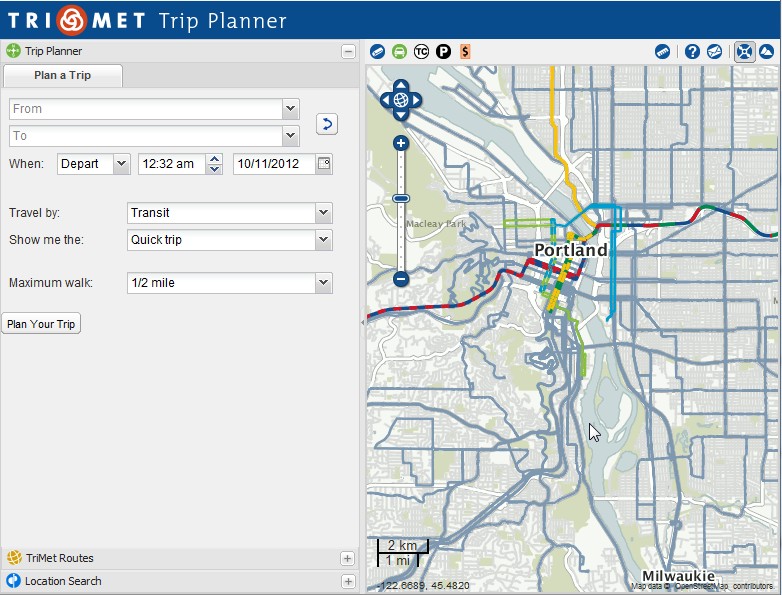
Services are already emerging to provide this information, such as Moovel (a commercial offering) and Open Trip Planner (a free service using crowdsourced data). They are just two examples of the ways in which the availability of information is making our cities more open and transparent. At the moment, both services are too new for us to make an assessment of their impact; but it will be fascinating to observe their progress.

(The Portland, Oregon implementation of Open Trip Planner)

The lesson of Game Theory is that this transparency – which I think of as “Open Urbanism” in this context – is what is required to enable and encourage all of us to make the sustainable choices that in their collective impact could make a real difference to the way that cities work.

I’d like to explore four aspects of Open Urbanism a little further to support that idea: Open Thinking; Open Data; Open Systems and Open Markets.

Open Thinking

The simplest expression of Open Urbanism is through engagement and education. In the afternoon plenary debate at the Rethinking Cities symposium, the inspirational Jaime Lerner spoke of a city recycling programme that has been operating successfully for many years; and that involves citizens taking the time to separate recyclable waste in return for no direct individual benefit whatsoever. So how were they persuaded to spend their time in this way?

It simply began by teaching children why sorting and recycling waste was important, and how to do it. Those children taught and persuaded their parents to adopt the behaviour; and in time they taught their own children. In this way, recycling became a cultural habit. Jaime later referred to the general concept of “urban acupuncture” – finding a handful of people who have the ability to change, and understanding what it takes to encourage them to change – a bit like planting a tiny needle in exactly the right place in the city.

Open Data

The information available about cities, businesses, current events and every other aspect of life is increasing dramatically; through the Open Data movement; through crowdsourced information; through the spread of news and opinion via social media; and through the myriad new communication forms that are appearing and spreading every day. The availability of this information, and the awareness that it creates amongst us all of how our cities and our world behave, creates a powerful force for change.

For example, a UK schoolgirl recently provoked a national debate concerning the standard of school meals simply by blogging about the meals that were offered to her each day at school, and in particular commenting on their health implications.  And my colleagues in IBM along with our partners Royal Haskoning and Green Ventures have helped the city of Peterborough to understand, combine, visualise and draw insight from information concerning the environment, the economy, transport and social challenges in order to better inform planning and decision making.

Open Systems

The next stage is to develop models from this data that can simulate and predict how the many systems within cities interact; and the outcomes that result from those interactions. IBM’s recent “Smarter Cities Challenge” in my home city of Birmingham studied detailed maps of the systems in the city and their inputs and outputs, and helped Birmingham City Council understand how to developed those maps into a tool to predict the outcomes of proposed policy changes. In the city of Portland, Oregon – as shown in the video below – a similar interactive tool has already been produced.

(A video describing the “systems dynamics” project carried out by IBM in Portland, Oregon to model the interactions between city systems)

As data is made available from city systems in realtime, these models can be used not just to explore potential changes in policy; but to predict the dynamic behaviour of cities and create intelligent, pro-active – and even pre-emptive – responses. We can collect and access data now from an astonishing variety of sources: there are 30 billion RFID tags embedded into our world, across entire ecosystems of activity; we have 1 billion mobile phones with cameras able to capture and share images and events; and everything from  domestic appliances to vehicles to buildings is increasingly able to monitor its location, condition and performance and communicate that information to the outside world.

These sources can tell us which parking spaces are occupied, and which are free, for example. Streetline are using this information in San Francisco to create a market for parking spaces that reduces traffic congestion in the city. In South Bend, Indiana, an analytic system helps to predict and prevent wastewater overflows by more intelligently managing the city’s water infrastructure based on realtime information from sensors monitoring it. The city estimates that they have avoided the need to invest in hundreds of millions of dollars of upgrades to the physical capacity of the infrastructure as a result.

If such information is made openly available to innovators in city economies and communites, surprising new systems can be created. At a recent “hackathon” in Birmingham, an “app” was created that connects catering services with excess food to food distribution charities who can use it.

(The QR code that enabled Will Grant of Droplet to buy me a coffee at Birmingham Science Park Aston using Droplet’s local smartphone payment solution; and the receipt that documents the transaction)

That same information can create an appeal to our sense of community and place. The city of Dubuque in Iowa provides citizens and businesses with smart meters that measure and analyse their water use. They can detect when domestic appliances are used on inefficient settings, or when there is a leak in the water supply.

pilot project in Dubuque found that people were twice as likely to act on this information when they were not only provided with insight into their own water usage; but also provided with a  score that ranked their water conversation performance compared to that of their neighbours.

Open Markets

To return to the initial subject of this article, interesting new technology-enabled systems such as local currencies are emerging that could embed information from open city systems into the pricing systems of new markets within cities – and thereby quantify the cost of “externalities” in those markets. For instance, the Brixton and Bristol Pounds are local currencies intended to reinforce local economic synergies; and in Birmingham Droplet are now making their first payments through their local SmartPhone Payment system which similarly operates between local merchants.

We are on the cusp of incredibly exciting possibilities. Local currencies and trading systems could enable marketplaces in locally-generated power; or in localised manufacturing using technologies such as 3D printing. They could exploit distribution systems such as the one that Amazon make available to their marketplace traders; and underground waste and recycling systems that take waste and recyclables direct from the home to the appropriate recycling and disposal centres.

I can only image the city systems that might result if these capabilities and sources of information were made openly available to innovators within city communities. They could create solutions that are Smarter than we can imagine. Personally I’m convinced that this “Open Urbanism” is an essential part of the journey towards the sustainable city of the future.

Ten ways to pay for a Smarter City (part two)

(Photo of the Brixton Pound by Charlie Waterhouse)

As I wrote recently, cities across the world are pursuing Smarter City strategies for common reasons including demographics, economics and the environment; but they start in very different social, financial and organisational positions. So there is a need to consider a variety of mechanisms when looking for the financial means to support those strategies.

Last week I discussed five ways in which cities can finance Smarter initiatives; they included tried-and-tested sources such as research grants, and more exploratory ideas such as sponsorship. In this post I’ll consider five more.

6. Approach ethical investment funds, values-led banks and national lotteries

Whilst the current state of the global economy has focused attention on the monetary aspects of our financial systems, in the context of Smarter Cities it is important to note that amongst the great variety of investment instruments are some which have social and environmental objectives.

I was honoured last week to attend the official opening of Sunderland’s new business support facility for social enterprises, Container City, operated by Sustainable Enterprise Strategies (SES). The centre, fabricated from 37 re-conditioned and adapted shipping containers, provides a new basis from which SES can support the hundreds of social enterprises and traditional businesses that they help to start and operate each year; and who provide services and employment in some of the city’s most disadvantaged areas.

Several of these organisations use emerging technologies in innovative ways to promote social outcomes in the city – such as Play Fitness whose “Race Fitness” product uses gamification to encourage children from deprived communities to engage in fitness and wellbeing; or See Detail who provide employment opportunities in software testing for people on the Autistic spectrum. I’ve argued before that this sort of innovation in communities can be a powerful force for making cities Smarter.

SES are supported by a variety of means, including financial institutions with mutual status, and funding programmes aimed specifically at encouraging social enterprise. The UK’s National Lottery provides one such programme, the “Big Lottery Fund“, which aims to support community groups and projects that improve health, education and the environment.

These sort of schemes operate in many countries, in addition to the ethical investment funds available in international markets. Community Interest Companies are another example of the new forms of organisation that are emerging to take advantage of them. Credit Unions and other forms of mutually owned or locally focussed financial institutions exist across the world; and the Global Alliance for Banking on Values recently issued a report stating that what it calls “sustainable banks” are outperforming their mainstream counterparts.

Such organisations will often demand a financial return in addition to social and environmental outcomes; but well-formed investment proposals for Smarter initiatives should be capable of meeting those objectives.

7. Make procurement Smarter

(Photo of a smart parking meter in San Francisco by Jun Seita)

Cities already spend hundreds of millions to billions of Pounds, Euros and Dollars each year operating city systems; and buying products, materials and services to support them. The scoring criteria in those procurements can be a powerful tool to create smarter cities.

Systems such as utilities, transport and maintenance of the environment are often contracted out to the private sector. If procurement criteria for those contracts are specified using traditional measures for the provision and cost of capability, then suppliers will likely offer traditional solutions and services. However, if procurements specify requirements for outcomes and innovation in line with a Smarter City strategy, then suppliers may offer more creative approaches.

Cities could specifically procure Smarter systems such as smart meters for water and power; or they could specify outcome-based procurement criteria such as lowering congestion or carbon impact in traffic systems; or they could formulate more open criteria to incent innovation and creativity. Jackie Homan of Birmingham Science City recently wrote a great article describing how some of those ideas are being explored in Birmingham and Europe.

8. Use legitimate state aid

A significant component of many Smarter City strategies is to stimulate economic and social growth in the less economically active areas of cities. Such initiatives often run into a “chicken-and-egg” or “bootstrapping” problem: new businesses need infrastructures such as broadband connectivity to start and succeed; but until an area has significant business demand, network providers won’t invest in deploying them.

Birmingham and Sunderland have both addressed this problem recently, winning exemptions from or avoiding conflict with European Union “State Aid” legislation to secure city-wide broadband deployments.

It’s important to make sure that such infrastructures are accessible. In the same way that a new city highway can divide the communities it passes through rather than linking them, it is important that new technology infrastructures are designed in consultation with local businesses and communities in order to provide capabilities they really need, through commercial models that they can afford to use.

Tax increment financing, which allows government bodies to use projected future increases in tax and business rates returns to justify investment in redevelopment, infrastructure, and other community-improvement projects, is another mechanism that can be used in this way. In the UK, the national government is undertaking an important extension of this thinking by agreeing a set of individual “City Deals” with cities such as Leeds and Birmingham, giving them new autonomous powers over local taxation and investment.

(Developers at City Camp Brighton explore ways in which collaboration and web technologies can contribute to the city’s future. Photo by Richard Stubbs)

9. Encourage Open Data and Hacktivism

Communities can bring great passion and resources to bear in finding new ways for their cities to work. In the domain of technology, this is exemplified in the phenomenon of “Hacktivism” in which volunteers lend their time and expertise to create new urban applications.

As I’ve discussed before, when this willingness to contribute is combined with the movement to Open Data and the transformation underway to regional shared services in public sector, powerful forces can be unleashed.

Code for America have championed this agenda in the United States, and this year Code4Europe was launched to promote a similar level of engagement in Europe.

There are limits to what can be achieved for free. But in my view great potential exists, particularly if City authorities can work in partnership with these movements to provide secure, scalable, open technology infrastructures that they can exploit.

However unfamiliar the produce, markets still need physical, infromation and governance infrastructure

10. Create new markets

For a long time I’ve considered that we should conceive of the platforms that support Smarter Cities not just as technology infrastructures, but as marketplaces – i.e. systems of transactions that take place on those new infrastructures. Marketplaces create money-flows; and marketplace operators can extract revenues from those flows which in return create the case for investing in the marketplace infrastructure in the first place. Further; by opening up the marketplace infrastructure to innovative local service providers, unforeseen new Smarter systems can be created.

There are many examples of new markets that use technologies such as social media and analytics to identify parties between which new transactions can be performed; and that then provide the infrastructure and governance to carry out those transactions. Craig’s List and E-Bay are well-known general marketplaces; whilst Freecycle specialises in the free distribution of unwanted items for re-use in communities. Zopa and Prosper apply these ideas to peer-to-peer lending and investment.

Similar markets with specific relevance to city systems are emerging. Streetline offer a Smarter Parking solution which could be viewed as a marketplace in parking spaces; and Carbon Voyage‘s system for sharing taxis can be seen as a marketplace for journeys. I’ve explored other examples of local, marketplace-based business models in food and energy in previous articles on this blog; and discussed some of the local currency and trading systems emerging to support them.

What these examples have in common is that they are independent businesses or social enterprises who are winning backing from investors because they have the potential to generate revenue. As I argued in the case of Open Data and Hacktivism above, if cities can find ways to support such innovative businesses, they’ll find another community that is able to help them achieve a Smarter City transformation.

The buck doesn’t stop here

The ideas for funding Smarter Cities that I’ve discussed over the last two weeks are certainly not exhaustive; and as a technologist rather than an economist or financier I certainly don’t consider them definitive.

But hopefully I’ve provided enough examples in support of them to demonstrate that they are realistic approaches with the potential to be re-used. I certainly expect to see them all play a role in financing the transition to the cities of the future.

Ten ways to pay for a Smarter City (part one)

Birmingham’s striking new Library, which will open in 2013, is one example of the regeneration projects currently underway in cities despite the challenging economic climate.

I’ve been meeting frequently of late with academic, public sector and private sector partners in city systems to explore the ways in which Smarter City initiatives are funded. Whilst many such programmes are underway, it is still the case that individual cities starting on this path find that it can take considerable time to identify and secure funds.

The ultimate stakeholder in Smarter City initiatives is often a local authority – they alone have the responsibility to ensure the functioning and success of a city as a whole. But whilst some reports show that private sector sentiment is finally improving following the 2008 crash, public sector – and in particular, local government – is still in the grasp of an unprecedented squeeze in funding. So where can city authorities look for the – sometimes substantial – funds needed to support Smarter City initiatives?

Up to now, a great many Smarter City initiatives have been funded at least in part by research grants. By their nature, these will only fund the first projects to explore Smarter City concepts – they will not scale to support the mass adoption of proven ideas. So we need to consider how they are used alongside other sources of funding.

In this post I’ll describe the first five of ten ways that Smarter City initiatives can be funded, including but not limited to research grants. None of them are silver bullets; but they all represent realistic ways to start paying for cities to become Smarter. I’ll describe another five in a follow-up post next week.

The UK Technology Strategy Board’s “Creative Industries Knowledge Transfer Network” (who took this photo) brings innovators in cities together to create new ideas.

1. Apply for research grants to support new Smarter City ideas

Whilst research funding will not pay for widespread adoption of proven Smarter City ideas, it will still support the search for new ideas. And we have certainly not exhausted the supply of ideas – far from it. In the UK, the Technology Strategy Board’s award of thirty £50,000 grants to perform “Future City” feasibility studies has kick-started a frenzy of activity. Just one of the thirty cities awarded these grants will be chosen to receive £24 million to support a demonstrator project; but many of the others will use the results of their feasibility studies to seek independent funds to move ahead.

The European Union recently launched an Innovation Partnership for Smart Cities and Communities that is expected to provide €365 million to support projects demonstrating innovative urban technology systems; and many funding programmes that are not labelled “Smart” or “City” are nevertheless relevant to Smarter Cities – such as the Technology Strategy Board’s “Innovating in the Cloud” funding competition or the UK Engineering and Physical Sciences Research Council’s “Research in the Wild” programme.

From social science to sustainability to healthcare to transport and buildings, many research agendas are relevant to creating the cities of the future; and new, well-formed ideas can always seek support from the relevant funding organisations. In this context, it’s not surprising that we’re seeing ever-closer links being forged between cities and the Universities that are located in them.

2. Exploit the information-sharing potential of shared service platforms

City and regional authority finances are under unprecedented pressure from the acute financial situation and expected demographic changes. In the developed world, we are getting older, and more people who have retired from work need the support of less people who are still working and paying taxes; and in emerging economies, urban populations are growing at a staggering rate.

In order to save money whilst maintaining vital services, local governments are increasingly sharing the delivery of support services such as finance, HR and IT; saving money – and reducing staff – in those functions in order to preserve the delivery of frontline services such as education and social care. It is difficult to overstate the significance of these changes; in the UK, for example, it is expected that nearly 900,000 public sector workers – 3% of the entire national workforce – will lose their jobs over the next five years as a result. Whilst specific characteristics vary from place to place, similar trends are visible across the world.

One outcome of these changes is that shared IT platforms are increasingly in place in cities and regions to support shared services. Those platforms now host co-located, multi-agency data. Cities such as Plymouth, Dublin and Sunderland are starting to explore the benefits that might be realised from that data. In Sunderland, the CEO and CIO have both spoken extensively about the opportunities they see to transform the city and services within it using their City Cloud platform. The East Riding of Yorkshire has been sharing services between agencies for some time, and has reported their achievements in addressing Child Poverty through improving cross-agency information sharing as a result.

These examples all show that whilst the current acceleration of shared services in cities and regions has its origins in adversity, it nevertheless offers the potential to support some positive outcomes too.

3. Find and support hidden local innovations

(Photograph by Meshed Media of Birmingham’s Social Media Cafe, where individuals from every part of the city who have connected online meet face-to-face to discuss their shared interest in social media.)

City populations are not passive observers to the Smarter City phenomenon. They may be crowd-sourcing mapping information for OpenStreetMap; running or participating in hacking events such as the forthcoming Government Open Hackday in Birmingham; or they may be creating new social enterprises or regional technology startups, such as the many city currencies and trading schemes that are appearing. Simply running social media surgeries as Podnosh do in Birmingham, can have a powerful effect on local communities by helping them exploit social technology to uncover hidden synergies and connections.

Individual officers in many councils work very positively with these community innovators. But substantial formal relationships can be impeded by the complexity of public sector procurement regimes which are simply too expensive and time-consuming for very small organizations to engage with. By simplifying procurement practices – or even by being transparent about the level of purchase below which competitive procurement does not apply – the level of engagement between city authorities and these communities could be increased. Bridging organisations can also play a positive role here, such as Sustainable Enterprise Strategies (SES) in Sunderland. SES provide support to the local social enterprise community and act as a link between that community and the City Council.

Local entrepreneurs and innovators often have limited resources. On their own, they are unlikely to implement such Smarter City infrastructures as energy grids or real-time transport information systems, for example. But collectively, their ideas could contribute significantly to the business case for a local authority to invest in such infrastructures. By engaging with this community extensively, a portfolio of potential innovations and outcomes can be created to demonstrate the value of such investments. By drawing on the collective creative energies of the city in this way, that portfolio is likely to contain many more ideas than could be obtained from central agencies alone.

4. Explore the cost-saving potential of Smarter technologies

At the heart of Smarter Cities is the idea that information integration and analytic technologies allow better, more forward looking decisions to be taken within cities; with the potential both to improve outcomes and to reduce costs. Whereas the desired outcomes may be citywide and social or environmental in nature rather than directly financial, many case studies show that short-term cost reductions can also be achieved within a single investing organisation. These cost reductions, of course, can then be the basis of an investment case – as they were for Sunderland’s City Cloud.

The London Borough of Brent in the UK, for example, realised significant cost savings by reducing error and fraud using such technologies, as did Alameda County in the US, who also identified new revenue opportunities (see this case study and this video).

As I dicussed in an earlier blog post exploring this topic, if these technologies are deployed on the shared IT platforms described above, then once in place they can be re-used for other purposes. This might lower the cost of deploying subsequent solutions elsewhere in city systems, such as traffic prediction for commuters in order to reduce the congestion that lowers economic productivity and job creation in cities; or predictive analytics to enable preventative approaches to social care, as demonstrated by Medway Youth Trust.

5. Could Smarter Cities be sponsored?

The Miami Dolphin’s Sun Life Stadium photographed by Bob Brown

In recent times we have become used to the idea that sports stadiums take their names from sponsors who fund the teams that own them, such as Arsenal Football Club’s Emirates Stadium. Such facilities are cities in microcosm in many respects, operating their own power, transport, safety and other systems analogous to those found in cities. Some, such as the Miami Dolphin’s Sun Life Stadium are already transforming those systems to become Smarter Stadiums.

Other facilities such as ports, airports, industrial plants, shopping malls and University campuses can be considered “micro-cities” in a similar way; and as I have commented before some of these are large enough that transforming their systems can make a significant contribution to transforming the cities in which they are based.

Could the concept of sponsorship be extended beyond sports stadiums? It has certainly been applied to entertainment facilities such as the O² Arena; and many airports have changed their names for marketing and branding purposes. 

I don’t expect we’ll see a city renamed by a corporate sponsor anytime soon, and novels such as Max Barry’s “Jennifer Government” and Rupert Thomson’s “Soft” have cautioned against such ideas. As past controversies around privatisation and commercialisation in areas of education and the justice system suggest, there are certainly city systems for which this idea could be challenging or simply inappropriate. But with cities increasingly conscious of the value of their brands in attracting investment and business, and with local employers conscious of the need for cities to seem attractive to the skilled people they need to employ, the possibilities for sponsorship to support some form of investment in appropriate Smarter City systems or facilities – especially those that are already private sector components of the city ecosystem – could be worth considering.

Funding the Smarter City roadmap

It’s very unlikely that any of the ideas I’ve discussed here will fund an entire Smarter City transformation, of course. But they are all realistic possibilities to fund elements of such a transformation. The challenge for cities is for their stakeholders to come together and agree how they will collectively exploit all of these ideas – and more – in funding the elements of a programme that they agree to undertake together.

Next week I’ll continue this discussion by exploring five more ways for cities to fund and support Smarter initiatives.

The amazing heart of a Smarter City: the innovation boundary

(Photo of a mouse by pure9)

Innovation has always been exciting, interesting and valuable; but recently it’s become essential.

The “mouse” that defined computer usage from the 1980s through to the 2000s was an amazing invention in its time. It was the first widely successful innovation in human/computer interaction since the typewriter keyboard and video display which came decades before it; and it made computers accessible to new communities of people for the first time.

But whilst the mouse, like the touchscreen more recently popularised by the iPhone and iPad, was a great innovation that increased the usability and productivity of personal computers, it wasn’t really necessary for a greater and pressing purpose. Its benefits came later as we explored its capabilities.

We now have a greater purpose that demands innovation: the need to make our cities and communities more sustainable, vibrant and equal in the face of the severe economic, environmental and demographic pressures that we face; and that are well described in the Royal Society’s “People and the Planet” report.

We have already seen those pressures create threats to food and energy security; and in recent months I’ve spoken to city leaders who are increasingly concerned with the difference in life expectancy between the most affluent and most deprived areas of their cities – it can be 10 years or more. There are much worse inequalities on a global scale, of course. But this is a striking local difference in the basic opportunity of people to live.

Barnett Council in North London famously predicted recently that within 20 years, unless significant changes in public services are made, they will be unable to afford to provide any services except social care. There will be no money left to collect waste, run parks and leisure facilities, clean streets or operate any of the other services that support and maintain cities and communities. I have spoken informally to other Councils who have come to similar conclusions.

All the evidence, including the scientific analysis of the behaviour and sustainability of city systems by the Physicist Geoffrey West, points to the need to create innovations that change the way that cities work.

But where will this innovation come from?

I think innovation of this sort takes place at an “innovation boundary”: the boundary between capability and need.

When a potentially transformative infrastructure such as a Smarter City technology platform is designed and deployed well, then the services it provides precisely embody that boundary.

This idea is fundamental to the concept of Smarter Cities, where we are concerned with the capability of technology to transform cities. Technology vendors – including, but not limited to, my employer IBM – are sometimes expected to use the Smarter City movement as a channel through which to sell generic technology platforms. As vendors, we do deliver technology platforms for cities, and they are part of the capability required to transform them. But they are not the only part – far from it. And they must not be generic.

(A smartphone alert sent to a commuter in a San Francisco pilot project by IBM Research and Caltrans that provides personalised daily predictions of commuting journey times – and suggestions for alternative routes.)

As I hope regular readers of this blog will know, I often explore the role of people and communities in transforming how cities work. A city is the combined effect of the behaviour of all of the people in it – whether they are buying food in a supermarket, traveling to work, relaxing in a park, planning an urban development or teaching in a school. No infrastructure – whether it is a road, a building, a broadband network or an intelligent energy grid – will have a transformative effect on a city unless it engages with individuals in a way that results in a change of behaviour. Work by my colleagues in IBM on transportation in California (pictured, left) and on water and energy usage in Dubuque, Iowa provide examples of what can be achieved when technology solutions are designed in the context of individual and community behaviour.

The innovations that discover how technology can change behaviour are sometimes very localised. They can be specific to the nature, challenges and opportunities of local communities; and are often therefore created by individuals, entrepreneurs, businesses and social enterprises within them. The “civic hacking” and “open data” movements are great examples of this sort of creativity.

But this is not the only sort of innovation that is required to enable Smarter City transformations. The infrastructures that support cities literally provide life-support to hundreds of thousands or millions of individuals. They must be highly resilient, performant and secure – particularly as they become increasingly optimised to support larger and larger city populations sustainably.

The invention, design, deployment and operation of Smarter City infrastructures require the resources of large organisations such as technology vendors, infrastructure providers, local governments and Universities who are able to make significant investments in them.

The secret to successfully transforming cities lies at the boundary between local innovations and properly engineered platforms. “Smarter City” transformations are effective when new and resilient information infrastructures are designed and deployed to meet the specific needs of city communities. One size does not fit all.

A technology infrastructure is no different in this regard to a physical infrastructure such as a new urban highway. In each case, there are some requirements that are obvious and generic – getting traffic in and out of a city centre more efficiently; or  making superfast broadband connectivity universally accessible. But other crucially important requirements are more complex, subtle and varied. How can a new road be integrated into the existing environment of a city so that local communities benefit from it, and so that it does not divide them? What access points, support and funding assistance are needed so that communities can use superfast broadband networks; and what services and information can be delivered to them using those networks that will make a difference?

If we understand those requirements, we can design infrastructures that properly support the innovation boundary. Doing so demands that we address three challenges:

Firstly, we must identify the specific information and technology services that can be provided to individuals, communities, entrepreneurs, businesses and social enterprises to help them succeed and grow. I’ve referred many times to the Knight Foundation’s excellent work in this area; it has inspired my own work with entrepreneurs and social enterprises in Sunderland and elsewhere.

(Meeting with social entrepreneurs in Sunderland to understand how new technology can help them)

Secondly, we need to understand and then supply the heavily engineered capabilities that are beyond the means of local communities to deliver for themselves; but that which enable them to create innovations with real significance.

At the 3rd EU Summit on Future Internet, Juanjo Hierro, Chief Architect for the FI-WARE “future internet platform” project, addressed this topic and identified the specific challenges that local innovators need help to overcome, and that could by provided by city information infrastructures. His challenges included: real-time access to information from physical city infrastructures; tools for analysing “big data“; and access to technologies to ensure privacy and trust. As we continue to engage with communities of innovators in cities, we will discover other requirements of this sort.

Finally, the boundary needs to be defined by standards. Many cities will deploy many information infrastructures, and many different vendors will be involved in supplying them. In order that successful local innovations can spread and interact with each other, Smarter City infrastructures should support Open Standards and interoperability with Open Source technologies.

It will take work to achieve that, of course. It is very easy to underestimate the complexity of the standards required to achieve interoperability. For example, in order to make it possible to safely change something as simple as a lightbulb, standards for voltage, power, physical dimensions, brightness, socket shape and fastening type, fragility and heat output are required. Some standards for Smarter City infrastructures are already in place – for example, Web services and the Common Alerting Protocol – but many others will need to be invented and encouraged to spread. Fortunately, the process is already underway. As an example, IBM recently donated MQTT, a protocol for connecting information between small devices such as sensors and actuators in Smarter City systems to the Open Source community.

(The first “Local Gov Camp” unconference in 2009, attended by community innovators with an interest in transforming local services, held in Fazeley Studios in Birmingham. Photo by s_p_a_c_e_m_a_n)

In the meantime, the innovation boundary is an amazing place to work. It puts me in contact with the leading edge of technology development – with IBM Research, and with new products such as the Intelligent Operations Centre for Smarter Cities. And it offers me the chance to collaborate with the academic institutions and thought-leaders who are defining the innovation boundary through initiatives such as “disruptive business platforms” (see this work from Imperial college, or these thoughts from my colleague Pete Cripps).
But more importantly, my work puts me in touch with innovators who are creating exciting and inspiring new ways for cities to work; often in the communities that need the most help, such as Margaret Elliott in Sunderland; Mark Heskett-Saddington of Sustainable Enterprise Strategies; and the team at Droplet in Birmingham.

I count myself terrifically honoured and lucky to have the privilege of working with them.

Are Smarter Cities the Key to Social Mobility?

(Photo of Santa Cruz by Cortto)

An interview with Chris Cooper, IBM UK Architect for Smarter Cities

My colleague Chris Cooper was recently appointed as IBM UK’s Architect for Smarter Cities. For many years Chris has helped IBM’s customers and partners in the transport industry build smarter systems with positive social and environmental impact; so he came to his new role with a wealth of experience.

Chris wrote a great paper a couple of weeks ago on the important connections between transport, open data and social mobility (it’s available here, though you need a subscription to access the full article). This week we explored those themes further in a discussion that I thought was worth sharing.

[Rick]: You’ve spoken and written about “Social Mobility” in the context of Smarter Transport and Smarter Cities; can you summarise what you mean by the concept?

[Chris]: Social mobility in the context of Smarter Transport systems is the ability to move people and resources in an informed way that achieves positive social outcomes. It relies on the use of information and communication technologies to facilitate the organisation and optimisation of connections between goods, services and human capital. In short, it can enable communities to work together to achieve their goals.

The real challenge for such systems is how to measure the value of their social, environmental and economic impact. Today, we measure value in monetary terms. But that’s very much a point-in-time measure; and there’s an argument that the full cost of goods and services are not identified and included in their financial price – particularly the social and environmental costs. It’s possible that such costs could be quantified by measures such as standard of living or the “happiness index” that has been suggested by the UK Prime Minister, David Cameron, amongst others.

I recently read a speech by Christine Lagard, Managing Director of the International Monetary Fund, ahead of the Rio+20 Summit. She called for a sustainable and equitably distributed recovery to economic growth; and stated that a barrier to achieving that was that the social and environmental costs you’ve referred to are not included in the prices we pay for goods and services. You’ve described “Social Mobility” as a vision for transport that addresses those challenges and empowers communities.

Yes, absolutely. But one of the challenges we will face is that the companies who operate our transport services are expected to peform against traditional financial measures – and they are audited in the same way. Those measures do not take account of social and environmental impact. If those measures were to be augmented by a “sustainability index” that assessed longer term contributions to society and the environment, then we might look back on current assessments of company performance and view them rather differently.

So if in the future mechanisms such as Carbon Taxes were introduced and became accepted components of financial performance, would we look back at the assessments we’re making today and consider them incomplete?

(Photo of carbon dioxide scrubber from Steve Simpson)

That’s very possible. Our current systems measure short term performance and don’t provide an incentive to plan for the future. It’s becoming more important to correct this as competition for our finite resources intensifies. To do so we need to introduce mechanisms to adjust the cost of resources to recognise their scarcity and the impact of consuming them.

A good precedent can be seen in the way we have combated acid rain. Social and political pressure resulted in the application of financial penalties to the use of the chemicals that contributed to acid rain. Over time those financial penalties made the causative chemicals prohibitively expensive to use; or made it cost-effective to install equipment to prevent their emission, such as the the carbon dioxide scrubbers that are now commonplace in power stations.

No-one argues with the logic of doing that anymore; and we no longer suffer from acid rain. Of course, in today’s globalised economy its important that such measures are applied universally so that they don’t create imbalances in competition, and that’s by no means a simple challenge to resolve.

At the Base Cities London conference we both attended recently, the Deputy Mayor for Environment for Los Angeles told us that in contrast to the relatively weak agreement between national leaders at Rio 20+, city leaders had returned from their own conference in Rio determined to implement the changes required to achieve sustainable economic growth. How do you see the ideas we’ve discussed working in city economies?

If companies published the “sustainability index” I’ve described, consumers could consider it when choosing which companies they should buy goods and services from. That could be a very powerful tool for influencing the impact of the millions of buying decisions made every day by individuals in local markets.

Rather than acting as an overhead or a barrier to innovation, such an index could enable companies to improve their performance. In order to transform operations to more measurably sustainable models, companies will need to invest in  understanding their supply chains, operations and markets in more depth. Doing so will undoubtedly provide opportunities for optimisation.

More generally, localism is going to be an increasingly important concept as we realise that it’s more realistic and effective to affect the communities around us rather than the world at large.

We haven’t spoken much about transport; I’ve seen some interesting studies recently that have highlighted the challenges some communities in cities have in accessing effective transport. To what extent is the concept of social mobility concerned with enabling city communities to travel to where they need to to live, shop and work?

That’s a really important point. The urban spaces we inhabit – including the surrounding rural spaces which supply them – need to be designed in harmony with the transport systems that move people and goods around them.

Whether that’s best accomplished by a “grid” system or through networks of urban villages; and how those ideas apply to new-build cities in emerging economies or the transformation of existing cities in developed economies are subjects that are hotly debated.

I personally think that mixed developments that concentrate a critical mass of people, goods and services within walking distance are the key to enabling the transactions through which cities create value and wealth to take place more frequently and at lower financial, social and environmental cost. Travel doesn’t just consume resources; it’s often an unproductive use of time.

So is it more important to focus on enabling travel within cities than between them in national systems?

Research has shown that cities are the most efficient systems for generating social and economic value; but it’s well known that some cities are losing population, or are losing key skills from their population to their suburbs and commuter belts. The reasons for that include the desire for more space; to live in more attractive environments; or to have better access to quality education for children. All of those challenges could be addressed by more holistic thinking, planning and investment in city systems, including their transport. And they would bring people with important skills and experience back into the diverse, creative environments of our cities.

One possible approach would be to allow cities to expand into the greenbelts surrounding them. By allowing cities and their transport systems to expand as little as one mile (1.5 kilometres) into their surrounding greenbelts – which are an artificial creation – we could significantly increase their size in a way that exploits their existing infrastructure.

Has the privatisation of transport in the UK over the past few decades resulted in a system that is cost-effective to provide – on a strictly financial basis – rather than one that is optimally beneficial to city communities and economies?

That’s certainly a concern, though key organisations in transport are starting to look ahead to new strategies for the future. Rather than focus on what we can’t predict – whether high-speed rail or hovercars will be our transport of choice, for example – I think we should focus on what we want our transport systems to achieve for us – such as universal access to local and national travel – and how we make progress towards such goals over the next few years.

So to summarise our discussion, would you agree that the challenge for cities is to evolve in ways that encourage the development of spaces, communities and transport systems in harmony so that they enable local transactions and interactions as a more sustainable form of growth?

(IBM’s Smarter City Technology Centre in Dublin)

Yes. It’s important for local communities, cities, regions and even nations to become conscious of their unique strengths; to exploit local transactions to reinforce them; and to trade them with regional and national partners.

Cities are increasingly looking for these differentiators; and multi-national companies such as IBM are looking to build relationships based on them. Such relationships – in Moscow, Dublin and Dubuque, for example – connect the ideas, experience and economies of scale that accrue from global operations to the intricacies and unique expertise of local markets. And they do it with the passion that comes from local engagement.

Chris, thankyou, that’s been a really interesting discussion. As individuals we all care about the places and communities in which we live; the ideas we’ve discussed today give us the reason and opportunity to contribute to those communities through our work as well as in our private lives in very important and exciting ways. 

How to pay for a Smarter City

(Photo of a halfpenny minted by Matthew Boulton in Birmingham; from Smabs Sputzer)

There are many definitions of what a Smarter City is; but a lot of them boil down to something that seems like common sense: spend some money doing things that have positive outcomes, rather than spending (much) more money trying (and often failing) to fix things that have gone wrong.

One reason that’s hard to do is that providing the accurate and holistic information needed to identify which preventative measures need to be taken where and when requires an investment in improving the systems that provide information to decision makers. That information might come from sensors on physical infrastructure; from people; from information systems; or from all of those sources.

Advances in technology are lowering the cost of collecting, integrating and exploiting that information; but the more fundamental problem is how to justify any investment at all in preventative action by one organisation when the benefits are realised by other organisations, some time later.

For example, (as is very well known) it has proven persistently uneconomic for network providers to deploy broadband coverage in areas with low economic activity. Despite the potential benefits to business and residents that technologies such as telecare and remote working could provide, there are simply not enough potential subscribers from whom network providers could collect revenues to recover the deployment cost. In most cases where this issue has been addressed, it is through Government or European grants – and those sources won’t provide a generally scalable financial model for Smarter Cities.

I haven’t figured out how to fix this; but I think I’ve realised what a couple of pieces of the puzzle are.

The global financial situation is forcing public sector organisations everywhere to make significant savings – around 10%-20% of their budgets. They can only do that by sharing capabilities such as IT services and back office processes. Of course, this results in job losses that cause real hardship, and I count friends, neighbours and colleagues among those who have lost their employment in this way.

But the resulting shared IT platforms do enable an opportunity to simplify the business case for investing in Smarter Cities. Those platforms can deliver IT capabilities to organisations in City regions at incremental cost. These days we call that Cloud Computing.

The multi-tenancy, automation of provisioning, and virtualisation of Cloud Computing enables capabilities paid for by a business case in one domain – such as predictive analytics and information portals – to be subsequently exploited at incremental cost in other domains. This way, business cases that to date have not been economically viable may now become so.

The majority of cities around the world need such capabilities to be available to Smarter City initiatives at incremental cost because they are not in the same financial positions as some of the most commonly referenced Smarter Cities. They do not have forthcoming global sporting events driving inward investment such as the Olympic Games or football World Cup, as London and Rio do. And they are not new-build cities in emerging economies such as China, paid for by strong growth in working populations and the economy.

For these cities, a Cloud platform can help them achieve Smarter City transformations through a carefully sequenced and co-ordinated series of investments, each of which is individually justified in one domain, but which adds capabilities that can then be cost effectively exploited elsewhere.

For example, case studies have shown how investments in information integration and analytic technologies can save money in delivering social care and reducing benefits fraud (see the examples from the London Borough of Brent in the UK and from Alameda County in the US (see this case study   and this video). In other cities where similar business cases are viable, information integration and analytics technologies could be deployed. If those technologies are made available to other City stakeholders through a regional Cloud platform on a commercial basis that reflects the ongoing operational cost of providing capacity, rather than the deployment cost of the platform, then the investment required to enable Smarter City solutions in other domains will be lower. It might make  traffic prediction solutions for commuters a viable investment to make, for example, in order to reduce the congestion that lowers economic productivity and job creation in cities.

This is likely to happen on regional city clouds rather than on nationally or internationally distributed public cloud infrastructures. The volume and velocity of the data required to generate timely insights based on holistic information means that the co-location of  data and analytics on a regional Cloud will be a vital for achieving the required performance and scalability.

I don’t claim that this approach will be straightforward or simple. The nature of Smarter City solutions in spreading across organisations, industry sectors and budgets will make the financial models and technology infrastructures – particularly in the areas of security, service management and resilience – a huge challenge.

But for the vast majority of cities, this approach is – in my opinion – the only way to make the investments that are required. I think 2012 will be a very significant year in the development of Smarter Cities. By the end of it, at the very least I’ll know whether I’m right or wrong.