Smart Cities should be defined by people and outcomes, not technology
April 12, 2024 1 Comment

It has been a busy few years since I last wrote this blog regularly, during which time the Smart City has grown up – to an extent.
For much of the last decade, the Smart City sector was dominated by grant-funded technology trials. There were exceptions, of course, particularly in the form of grass roots initiatives, which I’ll come to later.
However, the origin of the idea in 1990s California was more to do with social and economic growth and the resilience of communities.
Focussing on outcomes is a lesson I was cleverly taught by Sunderland City Council more than fifteen years ago. They had invited me and a few colleagues from IBM to come and discuss our Smart City programme with the CIO “and his team”, who we expected would include the Council’s leads on topics such as connectivity, cloud and data.
Instead, we were introduced to a local woman who told us about the company she had started with friends in the 1970s in a terraced house in Hendon, and the creche they’d set up because many of them were working mothers.
We had no idea what was going on.
Until … we learned that this was Margaret Elliot OBE, Managing Director of a £26m turnover employee-owned business, many of whose employees and owners were from the poorest wards in the city; and who had been a Cabinet Office advisor on social enterprise to Tony Blair’s government. The message, cleverly delivered and that I have never forgotten, was to stop thinking about technology, and to start thinking about how to help more people like Margaret and her colleagues succeed.
That was my introduction to Social Enterprise, the core of which – a financially sustainable operation to improve social, economic and environmental outcomes – should be the core of a Smart City. It’s how I’ve defined it ever since: how do we create better social, economic and environmental outcomes from the resources available to us?
Inevitably in today’s world, advances in technology allow us to answer that question in ways that weren’t possible before. Many successful grass roots smart city initiatives are structured this way – they start with the objective of making an improvement to a place, and technology is simply one of the tools they use.

Real smart cities are being built now. I’m working on projects around the world, particularly in the Middle East and Asia, that dwarf the wildest expectations I had a decade ago in their ambition for the role of technology, and in their sheer scale – they will be home to millions of people.
We have also seen incredible advances in technology in that time – supercomputers in our pockets and on our wrists, artificially intelligent personal assistants, 5G connectivity, immersive reality experiences, brain/computer interfaces and digital twins. They have been used by phenomenally successful businesses to change the way we shop, travel, recruit, learn and entertain ourselves.
Over the next few years, these will bring to life an idea I’ve been speaking about for a long time – “cities that work like magic”. Our AI personal assistants – who we are starting to trust to understand our preferences, schedules, social networks, physical condition and communications – will interface to us in every more intimate ways, and to the digital twins of our surroundings. They will mediate between us and a hybrid physical/digital environment that seems to respond to our needs before we’re aware of them, and that creates experiences we are only just beginning to imagine.
All of that is exciting, impressive – and challenging. It is a world completely different to the one I grew up in 50 years ago in the rural south of England; and it is one to which my teenage son and his generation will have a very different attitude to. They will be ultimately be the consumers of technology and the built environment, and they will choose how it works.

But whilst exploring those possibilities, we mustn’t forget Jane Jacobs’ lesson that the outcomes of cities are the emergent phenomena resulting from the outcomes of the lives and activities of their hundreds of thousands or millions of citizens; and that those are who and what we should focus on if we want to create great places.
For example, the one thing we can be sure of about the future careers of today’s children, is that they will involve working with artificial intelligence in augmented reality environments.
Are schools today equipped to introduce children to those technologies? For the most part, they are not. So the children of the relatively affluent parents who can afford to explore those technologies themselves will get an early advantage over those who cannot.
Some smart city initiatives address these challenges directly, because they start by establishing the values that are shared by communities and stakeholders in a place: inclusive, sustainable growth; health and wellbeing; vibrant communities and quality environments.
For example, the Birmingham-headquartered technology company SCC recently launched an Academy to provide free basic digital training to people from some of the city’s most deprived wards, near to their headquarters in Tyseley, working in partnership with local community organisations. With so much training and recruitment now taking place online, people who are not online have access to ever fewer opportunities, so the Academy is addressing a real barrier to social mobility. And Birmingham Digital Futures, a partnership started by the University of Birmingham along with major employers and institutions, is working with grass roots and community organisations across the city to deliver improved digital education.
The SCC Academy and Birmingham Digital Futures are great examples of Kelvin Campbell’s “Massive / Small” principle: that we need to combine top-down resources and influence with bottom-up resourcefulness and embeddedness in place and community – to create “massive” amounts of “small”-scale innovation.
In my experience, this is one of the most important concepts in the Smart City. Grass roots initiatives are often the only way to create real change and embrace diversity, but they rarely scale on their own. This is not about “top-down versus bottom-up” – it is about both approaches working in creative, sympathetic harmony.
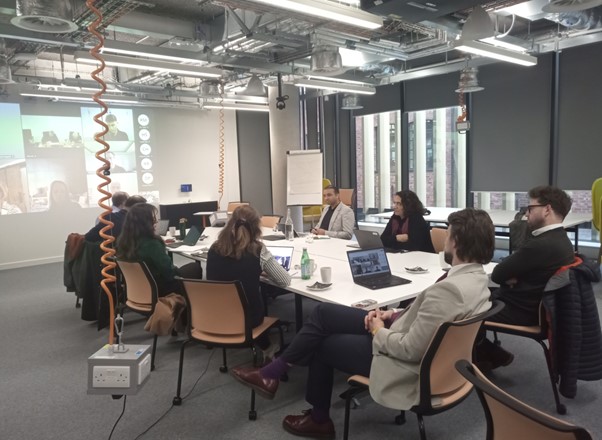
My work in Smart Cities always starts with two fundamental activities: speaking one-to-one to as many stakeholders as possible; and agreeing a set of values with them that guides everything we do together.
That naturally leads us to consider challenges such as education and social mobility and initiatives to address them in our plans, where technology is an enabler, not the objective. It also naturally leads us to consider the needs of developers and investors to operate profitably and to realise a return on their investment.
The good news is that when a long-term, collaborative, place-based view is taken, those motivations come together.
It’s this process that led to the establishment of the Birmingham Digital Partnership in 2022, which I was delighted to be asked to Chair, re-energising the Digital Birmingham brand, supporting initiatives in data-sharing, connectivity and business digitalisation, and working in partnership with Birmingham Digital Futures and organisations such as West Midlands 5G and Bruntwood’s Innovation Birmingham Campus.
It’s amazing to see the progress that’s been made in smart cities in recent years, and a thrill and a privilege to be part of it. But we mustn’t forget that this is about people and outcomes, not technology.
 The Urban Technologist